
What your body has been trying to tell you about aging.
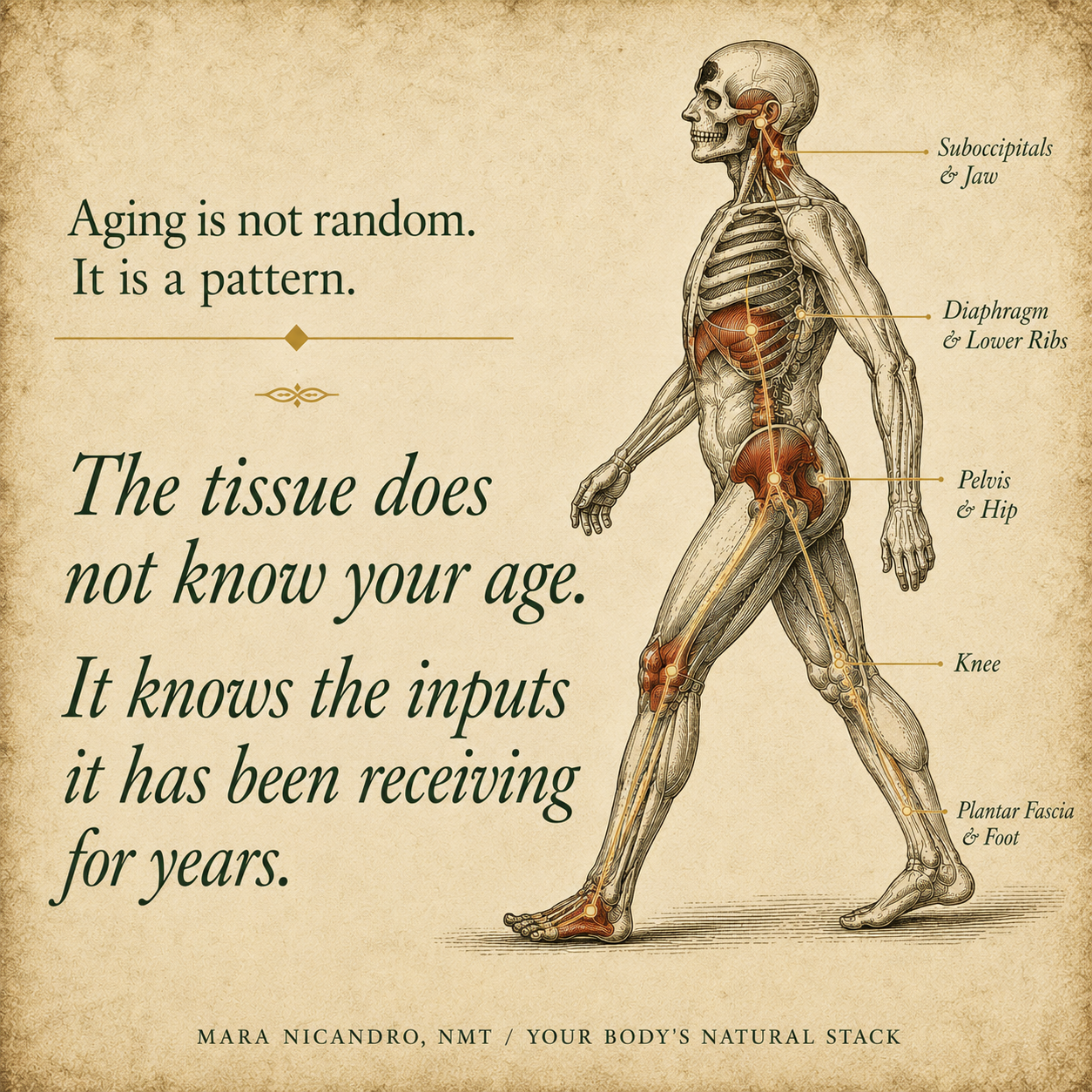
I have been in clinical practice for 23 years. I have worked with bodies in their 30s, 50s, and 70s. And the thing I keep seeing, the thing most standard aging protocols do not fully account for, is that aging does not create the patterns I find in tissue. The patterns were already there. Aging accelerates them.
I see a 55-year-old woman managing neck tension, jaw loading, fatigue, poor sleep, and hormonal disruption who has been told this is simply what getting older feels like. I see a woman in her 30s, desk-bound, under chronic load, presenting the exact same compensation chain. Different age. Identical pattern.
The tissue does not know her birthday. It knows the inputs it has been receiving for years.
She just knows she wakes up tired, feels heavy in her own body, and no longer feels like her system is working with her.
Aging is not a mystery. It reflects the inputs your body has been adapting to for years. Most aging frameworks address outputs. This one addresses the pattern.
The Pattern I See Before Anything Else
Before I name a single category, I want to tell you what I observe in a body that has been compensating for years.
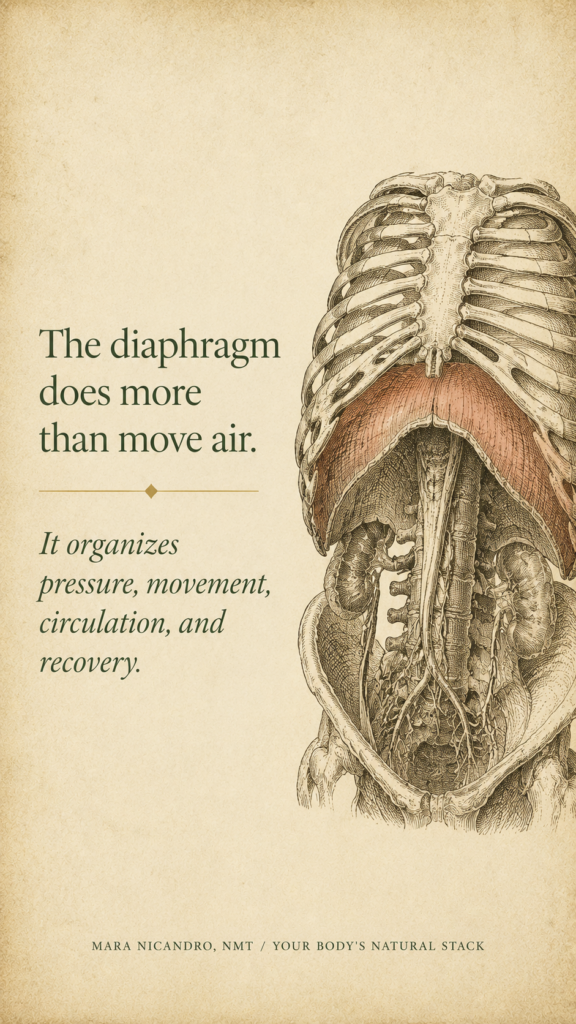
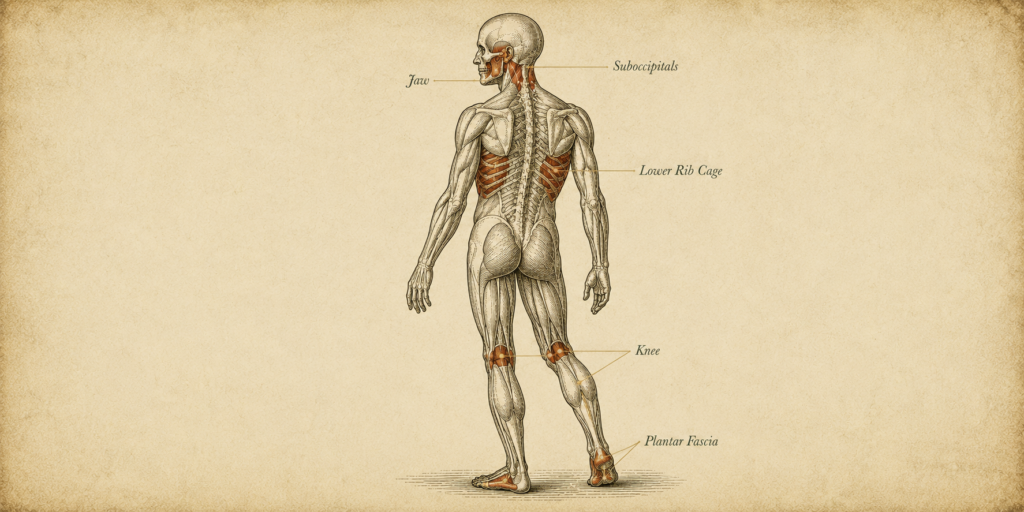
The head is heavy. Not metaphorically. Literally forward and down, pulling against suboccipital muscles that have been holding load for years. The jaw has shifted, often with a click that has been present long enough to feel normal. The temporalis and masseter are dense. The sinus tissue is congested. The lower rib cage is held, not from strength, but from the diaphragm having handed its role to muscles that were never designed to manage pressure full time.
The feet are thick. The toes have stopped coordinating with the rest of the body. The plantar fascia is carrying load it should not have to carry because proprioceptive input from the ground stopped being reliable and the whole system adapted by bracing instead of moving.
And in clinical practice, the tongue is almost always part of the compensation. Pressed to the floor of the mouth, forward, or pulled back. Part of a body-wide strategy for stability.
The body adapted long before it became symptomatic.
None of this is aging.
All of it is what aging accelerates.
Here is the framework that addresses it.
In my practice, the pattern often shows up in five places first: the feet, the pelvis, the ribcage, the jaw, and the neck. These structures are constantly exchanging information about balance, pressure, breathing, and stability. When one area begins compensating, the others adapt around it.
Aging often reveals this pattern. It does not create it.
The feet, pelvis, ribcage, jaw, and neck are not separate conversations. They are one coordinated system adapting to the inputs it receives every day.
The categories that follow are not independent interventions. They are inputs that influence how that system adapts over time.
1. Protein
Not just how much. How it is distributed, when it is consumed, and whether the body can actually absorb and utilize it.
Muscle is a metabolic organ. It is the primary site of glucose disposal, one of the strongest drivers of resting metabolic rate, and one of the tissues most responsible for joint integrity and postural stability. Every other category on this list depends on it.
The issue is not that most people ignore protein. It is that they under-eat it and distribute it poorly. A small amount at breakfast. Most of it at dinner. Below the anabolic threshold at nearly every meal.
After 40, anabolic resistance increases. The body becomes less efficient at converting dietary protein into muscle tissue. The threshold goes up, not down.
Most people are eating less protein precisely when they need more.
The research on protein and muscle preservation is consistent. Adequate intake distributed throughout the day, prioritized earlier rather than later, supports muscle protein synthesis more effectively than the same amount consumed mostly at dinner. The specific targets and food sources are worth discussing with a qualified nutrition professional, but the principle is clear: most people are eating less protein than they need and distributing it in a way that undermines the benefit.
2. Resistance Training
The structural anchor of everything else on this list.
Bone density, insulin sensitivity, postural integrity, joint stability, hormonal resilience, metabolic health. All of it depends on load stimulus.
This is not a fitness conversation. It is a tissue quality conversation.
Muscle does not maintain itself. It responds to load or it atrophies. Research on sarcopenia is unambiguous. Age-related muscle loss begins in the 30s and accelerates with each decade. It is not inevitable. It is the predictable result of insufficient stimulus.
But load applied before the system can sense itself accurately does not build strength. It deepens the compensation pattern.
Clinically, what I see when someone begins resistance training before proprioceptive integrity is established is joint compression or hypermobility, and a disconnection in left-right recruitment, particularly on the left side, that reflects a motor control issue not a strength deficit. The brain cannot recruit what it cannot accurately sense. Loading on top of that pattern drives the compensation deeper.
The entry point before load is coordination. The deep stabilizing system needs to be online first. Proprioceptive demand should be embedded in every session throughout the training life. The breath mechanics, the midline coordination, the left-right recruitment awareness are the foundation every session returns to.
One of the strongest predictors of healthy aging is not flexibility. It is the ability to accurately sense and control the body in space. Research consistently shows that balance, gait quality, and movement confidence predict independence and longevity as we age. Proprioception is the sensory foundation supporting all three. This is why coordination before load is not just a clinical preference. It is a longevity argument.
You cannot load a system that cannot sense itself accurately. And the load only becomes therapeutic when the sensing stays present throughout it.
The distinction that matters beyond that is progression versus maintenance.
Most people are maintaining. Same weights, same repetitions, same movement patterns for years.
Maintenance preserves what you have. Progression builds.
After 40, you need both and you need to know which one you are doing and why. Working with a qualified movement professional to build a progressive program that matches your current proprioceptive foundation is worth the investment. The frequency and structure matter less than the sequencing — coordination before load, always.
3. Sleep and Stress
The glymphatic system is the brain’s drainage network. It becomes most active during deep sleep, particularly slow-wave sleep. During this window the brain clears metabolic waste through cerebrospinal fluid exchange, including proteins associated with cognitive decline.
If deep sleep is compromised, clearance is compromised.
Cortisol is the structural mechanism connecting stress to accelerated aging. Chronically elevated cortisol degrades muscle tissue, disrupts insulin signaling, suppresses immune function, and interferes with recovery and hormonal balance.
This is not a mood issue. It is a tissue issue.
The clinical layer most people miss is that jaw loading, suboccipital tension, shallow breathing, and chronic sympathetic activation disrupt sleep architecture long before someone recognizes they have a sleep problem.
The body cannot downregulate because it has organized around vigilance.
The head is heavy. The jaw is braced. The breath is shallow.
This pattern often starts earlier than most people recognize. The body learns to hold before it learns to rest. Signals that once felt urgent — tension, gripping, shallow breath — become background noise. Not because they resolved. Because the threshold shifted. The body adapted around them. By the time sleep is disrupted, the pattern has been running for years.
One of the clearest signals is breath. When the rib cage is held and the diaphragm has handed its role to secondary muscles, a full breath becomes difficult to access. That sensation — the inability to take a complete breath — can feel alarming. It is not a lung problem. It is a pressure management problem. The system has been recruiting the wrong muscles for so long that the primary breathing mechanism has partially disengaged.
The system stays alert even during rest.
Sleep is not passive recovery. It is an active biological input.
Protect it with the same precision you apply to training.
4. Hormonal Resilience and Tissue Quality
Hormonal shifts do not just affect mood or reproduction. They affect tissue quality, connective tissue integrity, recovery capacity, and how the nervous system organizes stability.
Estrogen, progesterone, and testosterone influence collagen synthesis, muscle recovery, proprioception, bone density, vascular function, and connective tissue resilience. As those inputs change, long-standing compensation patterns often become more visible.
Clinically, this frequently shows up before someone realizes hormones are even part of the conversation.
The gripping hand. The jaw that never fully relaxes. The tongue pressing for stability. The glutes no longer coordinating efficiently during gait.
These are not random changes.
They are often the nervous system adapting to altered tissue quality, altered recovery capacity, and years of compensation patterns becoming more neurologically ingrained under chronic load.
This is why symptoms that appear unrelated, sciatica, frozen shoulder, dizziness, brain fog, jaw tension, shallow breathing, can share the same upstream pattern of pressure management, proprioceptive loss, and structural compensation.
Hormonal support is an individualized medical conversation to have with a qualified physician. But structurally, the relationship between hormones, tissue quality, and aging cannot be ignored.
5. Collagen and Fascial Integrity
Most people think of collagen as a skin supplement. Clinically, it is far more significant than that.
Fascia holds the majority of the body’s water. It is not just structural wrapping tissue. It is a fluid transport medium that moves water, nutrients, and cellular waste through the interstitium, the fluid-filled space between your cells. Collagen is the primary structural protein that gives fascia its tensile integrity and its capacity to hold and move that fluid.
When fascial hydration degrades, tissue becomes dense, restricted, and adhesive. It loses its ability to glide, transmit force efficiently, and move fluid where it needs to go.
The heavy head gets heavier. The restricted breath gets shallower. The jaw pattern becomes more ingrained.
Drinking more water does not solve this on its own. Tissue quality, movement, and fluid exchange determine how effectively hydration can be utilized.
Collagen supplementation may support synthesis, but it requires movement, vitamin C, glycine, resistance training, and sleep to become functional tissue.
Passive intervention alone, whether bodywork, stretching, or supplementation, addresses the tissue without updating the pattern organizing it. It bypasses the voluntary contraction and motor cortex feedback loop that creates lasting tone change. The tissue responds. The pattern reasserts. This is why no single input works in isolation. Fascial integrity requires load, breath mechanics, proprioceptive demand, and adequate sleep working together. The tissue change holds when the system supporting it holds.
From a clinical standpoint, fascial hydration and tissue quality are among the clearest aging markers I observe. Age matters. Input quality matters too.
The lymphatic system has no central pump. It moves through breathing, muscle contraction, and tissue movement. Fascial tissue is part of the pathway through which that fluid travels. When movement decreases and tissue becomes dense and adhesive, hydration, nutrient delivery, and waste removal all become less efficient. The pattern becomes harder to shift because the environment that supports change has become stagnant.
The jawline changes most people attribute purely to aging, bone resorption, fat pad shift, fluid accumulation, are accelerated by the same compression pattern in the masseter and cervical lymphatics that the rest of this framework addresses.
6. Cardiovascular Capacity
Cardiovascular health is not built only through high-intensity output. The nervous system regulation pathway matters as much as aerobic demand.
Tai Chi and Qigong produce measurable improvements in heart rate variability, blood pressure regulation, vagal tone, and proprioceptive integrity. They work through coordinated breath and movement rather than cardiovascular demand alone. That is a different input and a complementary one.
The stacking method layers breath mechanics into movement from the foundation up. Nasal breathing coordinated with load, rhythm, and positional awareness trains the nervous system to maintain pressure management and proprioceptive integrity under demand. That integration is what makes movement therapeutic rather than simply effortful.
Yoga practiced without attention to breath mechanics and oblique subsystem coordination can reinforce the same compensation pattern it appears to address. The range of motion improves. The neural edge that stabilizes and integrates that range does not automatically follow. For many people the dominant side gets more dominant, the restricted breath stays restricted, and the flexibility is built on top of a pattern rather than through it. The practice itself is not the issue. The foundation it is built on determines whether it resolves the pattern or layers over it.
Doctors frequently recommend yoga and movement for low back pain. That recommendation is not wrong. What it misses is that a nervous system organized around protecting the low back will brace, grip, hold the breath, and restrict spinal motion even when movement is the intention. The low back does not need to be mobilized before it feels safe to move. It needs accurate breath mechanics and midline coordination first. Without that foundation spinal movement triggers the same bracing, breath holding, and grip pattern that organized the compression in the first place.
Nasal breathing is not just a technique. It is a vascular input.
Nitric oxide is produced in the paranasal sinuses during nasal breathing. It supports vasodilation, oxygen delivery, blood pressure regulation, and vascular health.
Chronic mouth breathing bypasses this entirely.
The breathing pattern someone lives in daily becomes part of their cardiovascular environment over time. Clinically, nasal breathing is one of the first cardiovascular-related inputs I assess because it influences oxygen delivery, vascular function, and pressure regulation.
The foundation has to be there for the rest of the system to build on.
7. Blood Glucose Regulation
Insulin resistance is upstream of many of the patterns associated with accelerated aging.
It affects hormone function, inflammatory load, sleep quality, cognitive resilience, muscle recovery, and cardiovascular health.
And it develops years before diagnosis.
The practical inputs that support insulin sensitivity are well documented and accessible. The research consistently points toward movement, meal composition, and timing as the primary levers. These are not extreme interventions. They are foundational inputs worth exploring with a qualified nutrition or medical professional.
8. Chewing
Most aging frameworks focus on what you eat. Few pay attention to how you eat.
Thorough chewing influences satiety, appetite regulation, digestive preparation, and metabolic health. People who chew less and eat more quickly tend to consume more calories and show a higher association with obesity and metabolic syndrome risk factors.
But the clinical argument goes deeper than digestion.
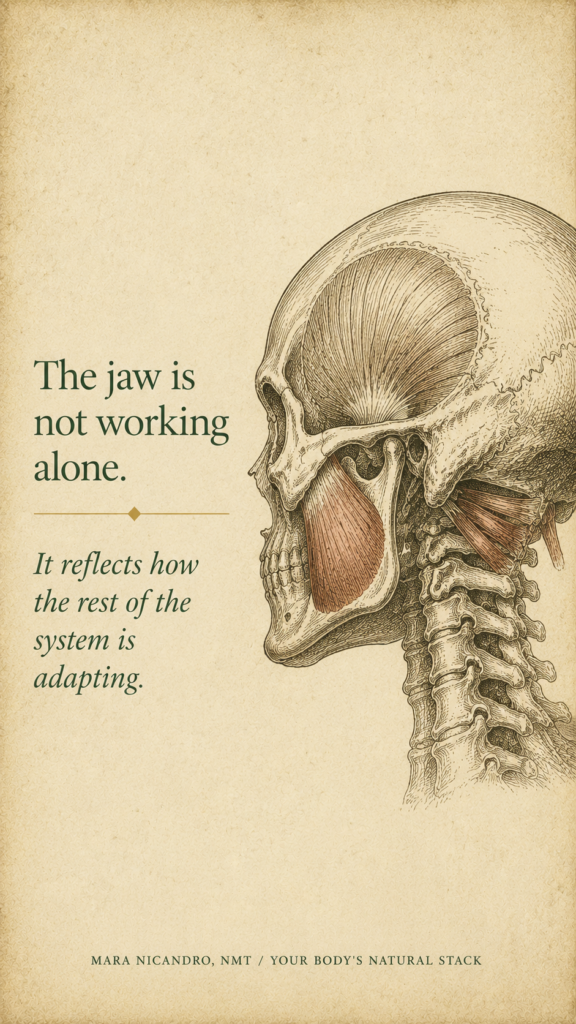
A functionally healthy jaw requires sensory input. Varied texture, resistance, and proprioceptive feedback through the teeth, periodontal ligament, and joint mechanoreceptors. That input is what keeps the masseter operating as a chewing muscle rather than a stabilizer. In clinical practice, when the interstitium is congested and the mechanoreceptors cannot transmit accurately, I observe the jaw losing its proprioceptive reference and the masseter bracing to compensate.
The bite guard addresses the consequences of that loading, tooth wear and joint compression, without changing why the masseter is loaded. The pattern continues. The compression continues. The lymphatic drainage from the head and neck remains compromised.
Chewing is not about counting or following a rule. It is about restoring sensory input to a system that has been running on congested tissue with degraded feedback. Slower, more deliberate eating with attention to texture and resistance is how you begin to restore that input.
9. Absorption, Hydration, and Nutrient Delivery
You can eat well, supplement correctly, and still remain undernourished.
Most people eat in a dehydrated state without realizing it. Mild dehydration reduces saliva production, slows gastric motility, decreases digestive enzyme activity, and impairs intestinal transit. The digestive system requires adequate hydration to function as a delivery mechanism, not just as a processing one.
Supplements taken in a dehydrated state face the same barrier. Fat soluble vitamins require bile flow and intestinal fluid. Minerals need cellular hydration for uptake. Water soluble vitamins depend on transport mechanisms that hydration status directly affects.
Drinking water with a meal is not always the solution. It can dilute stomach acid and digestive enzymes at the moment they are most needed. Timing water intake around meals rather than during them supports the digestive environment without making hydration a chore or a rule to follow.
Absorption depends on stomach acid, bile flow, gut lining integrity, inflammatory status, sleep quality, and nervous system regulation. All of these are compromised by chronic dehydration and all of them degrade with age.
The body stops asking clearly for what it needs. That is not a hydration problem. It is a systems problem.
10. Oral Health
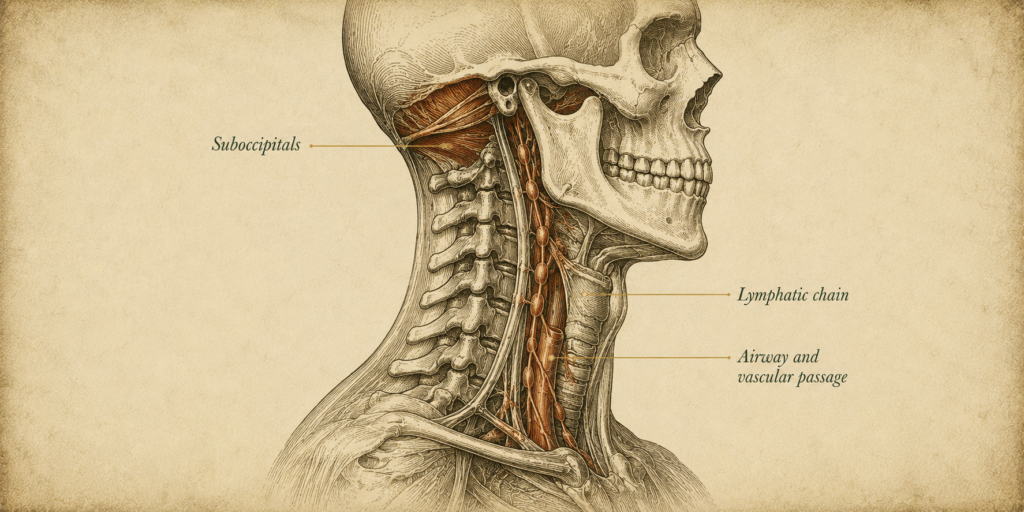
The neck is the only place in the body where the nervous system, vascular supply, lymphatic drainage, and airway share the same passage. The compensation patterns that load the suboccipitals, jaw, and cervical spine are compressing all four simultaneously. That is not a neck problem. That is a systems problem with a neck address. Oral health, tongue position, jaw loading, and nasal breathing all feed directly into that shared passage.
Oral health is not separate from systemic health.
Periodontal disease is associated with cardiovascular disease, insulin resistance, cognitive decline, and chronic inflammatory load.
The mouth is an immune interface.
When the oral environment becomes chronically inflamed, the signal is systemic.
Clinically, I also look at the mechanical environment: mouth breathing, tongue position, jaw loading, cervical congestion, vagal tone, and lymphatic drainage.
Salt-water gargling, tongue scraping, nasal breathing, oral hygiene, and reducing oral bacterial load are not cosmetic rituals.
They are biological inputs.
11. Structural Integrity
The category most aging frameworks leave out entirely.
Aging is not only a loss of tissue quality. It is also a gradual loss of sensory precision. The nervous system becomes less accurate at reading position, pressure, and movement over time. That degradation is not inevitable. It is the predictable result of compensation patterns that have progressively reduced the quality of sensory input the body receives.
A compensation pattern that was adaptive at 35 becomes degenerative at 55.
The body is remarkably intelligent. The body borrows stability from whatever structure it can recruit. Load gets redistributed. It reorganizes around deficits and adapts.
Until the adaptation becomes too expensive.
What most people call aging is often the moment compensation stops being sustainable.
The heavy head is not just posture. The jaw click is not just a joint. The thick plantar fascia is not just a foot issue.
They are structural expressions of a system that has been compensating for years.
The knee is one of the most common pain addresses in the body not because it is fragile but because it sits between two major compensation drivers. When foot proprioception fails and the pelvis loses neutral, the knee absorbs the mismatch between them. It is not the origin of the pattern. It is where the pattern becomes too expensive to ignore.
Nowhere is this more clinically clear than in jaw pain. The teeth are the address. They are not the origin. Most people with chronic jaw tension, clicking, grinding, or facial pain have been told the problem lives in their bite or their stress levels. Clinically, the jaw is loaded because the pattern running through the suboccipitals, the hyoid, the diaphragm, and the lower body created an environment where the jaw became a stabilizer. Address the pattern and the jaw changes. Address only the jaw and the pattern keeps feeding it.
The transitions that reveal this most clearly are the ones that demand the most from the system. Pregnancy and postpartum. Surgery and recovery. A new training practice — resistance training, yoga, Pilates — where proprioceptive demands suddenly increase. Low back loading that appears with any of these transitions is rarely a spine problem. It is the pelvis and diaphragm losing their coordination under new demand. These are not separate events. They are moments when a compensation pattern that was manageable becomes expensive. The body needs structural integrity before it can build on it. Without that foundation the transition loads the pattern instead of resolving it.
Most people have been told stretching helps. The science confirms it changes the tone of the muscle temporarily. Within an hour the tissue returns to where it was because the neural pattern organizing that tone has not changed. The difference between stretching and pandiculation is the difference between addressing the tissue and updating the brain’s map of it. Pandiculation works through the motor cortex directly — voluntarily contracting a muscle, slowly releasing it, and then relaxing completely. It resets the nervous system’s baseline tone rather than temporarily altering peripheral feedback. One bounces back. The other builds the neural edge that keeps the pattern from reasserting itself.
This is the same framework I expand on throughout Your Body’s Natural Stack: Rediscover Balance Through Breath and Alignment.
The feet, pelvis, ribcage, knee, jaw, and neck are not separate conversations. They are one adaptive system responding to the inputs it receives every day.
These Are Not Eleven Separate Interventions
Every category on this list affects every other category.
Protein without absorption is partial. Resistance training without sleep is undermined. Hormonal support without structural integrity leaves connective tissue unsupported. Cardiovascular training without nasal breathing misses a vascular input. Oral health without mechanical activation leaves congestion patterns unchanged.
The pattern either gets addressed upstream or it presents downstream.
In the bodies I have worked with for 23 years, the people who age well are not doing one thing correctly. They are maintaining coherent inputs across the entire system.
The ones who struggle are often managing symptoms at each address without ever identifying the pattern organizing them.
The body is always adapting.
The question is whether the inputs guiding that adaptation are helping you age with resilience or reinforcing the same compensation patterns year after year.
And this matters at every age. The woman in her 30s running the same pattern as the woman in her 55s is not destined to arrive at the same outcome. Functional patterns return to sustainable health when the inputs change. The body does not know your age. It knows what you are giving it. That is the most important clinical truth in this entire framework.
Your body is like a garden. Tend to it every day and it will thrive. The eleven inputs in this framework are not treatments. They are the daily tending. The body does not need to be fixed. It needs to be given what it has always needed to do what it already knows how to do.
Deeper breathing is not about relaxation. It is the physiological condition the body needs to stop running a pattern it no longer needs.
When the pattern shifts and the body is no longer spending its resources on compensation, things that required constant management often require less. Not because the interventions were wrong. Because the system finally has what it needed.
Mara Nicandro, BCTMB, is a Board-Certified Neuromuscular Therapist with 23 years of clinical practice in Chicago. She runs NMT4Health Chicago out of a Wicker Park studio and is the author of Your Body’s Natural Stack: Rediscover Balance Through Breath and Alignment.
If pain, tension, fatigue, or stiffness keeps returning, a Discovery Session is where we identify the pattern your body has been adapting around.
Not ready to book? Start with the 7-Day Reset Workbook — a framework for understanding your pattern and beginning to shift it.
