
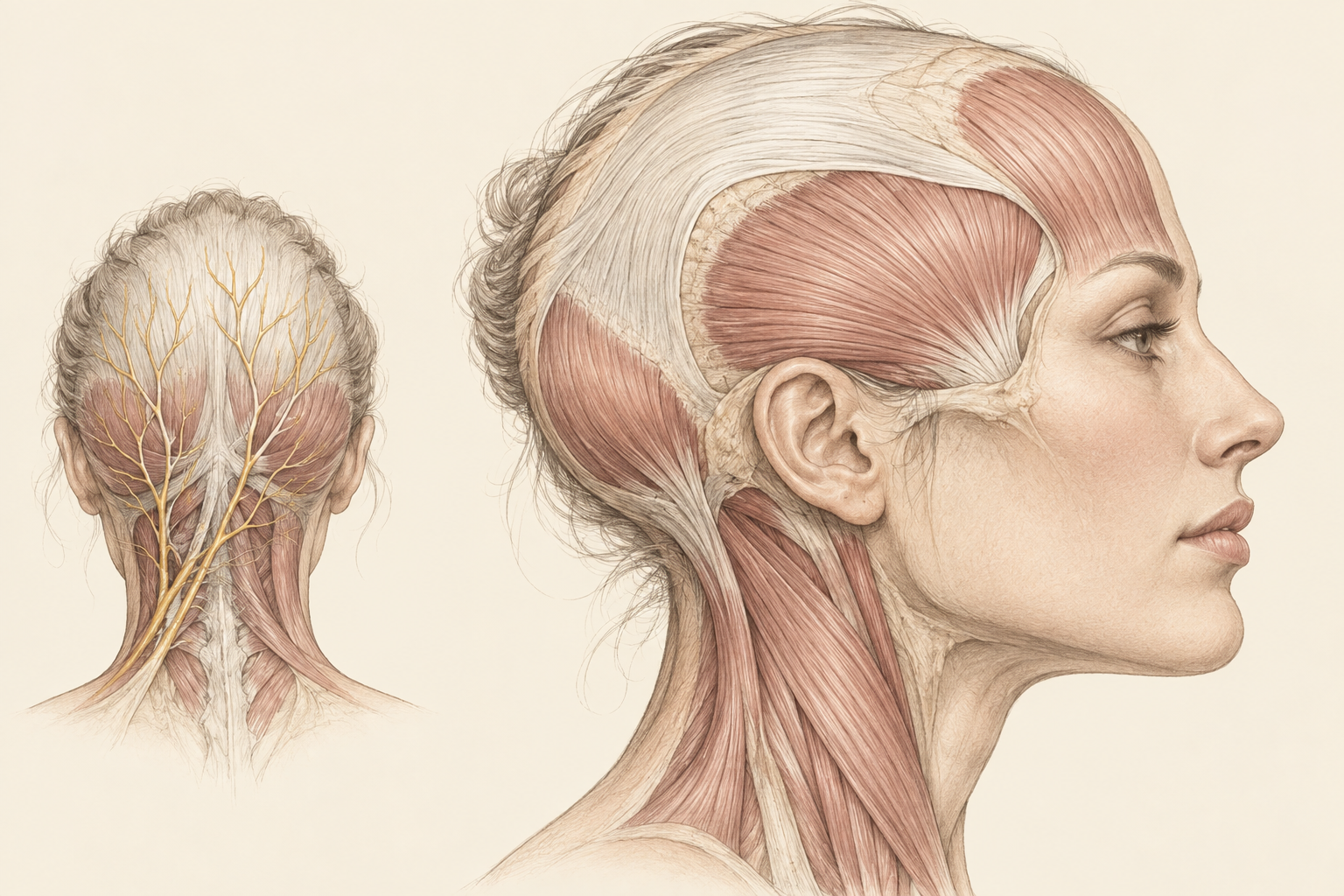
A headache at the base of your skull. A forehead that feels tight. Your scalp feels tender when you brush your hair.
These sensations bring your attention to the place you feel them. Beneath that place are muscles, connective tissue, and nerves, each with a different role.
Understanding the anatomy gives us context. Meanwhile, observing how you stand, move, and breathe adds another piece.
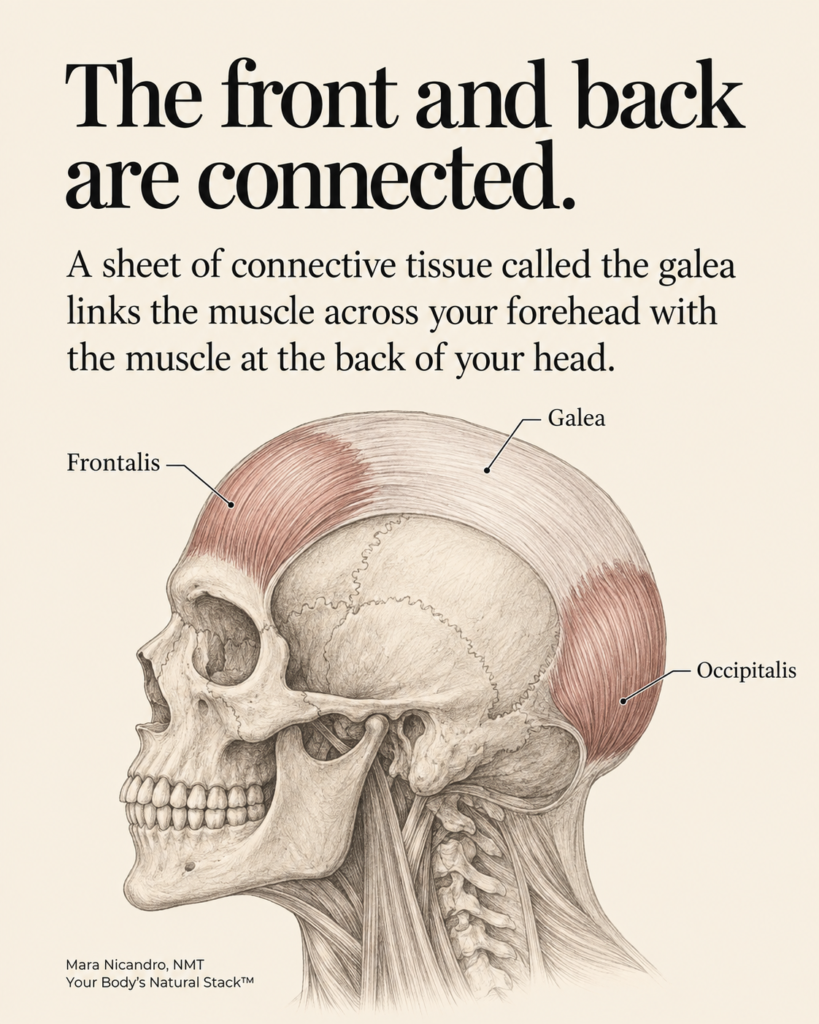
The front and back of your scalp are connected
A sheet of connective tissue called the galea aponeurotica spans the top of your skull. It connects the portions of the occipitofrontalis muscle at your forehead and the back of your head.
However, a tight forehead, tender scalp, or skull-base headache can have several explanations. The useful starting point is what you feel, when it appears, and what accompanies it.
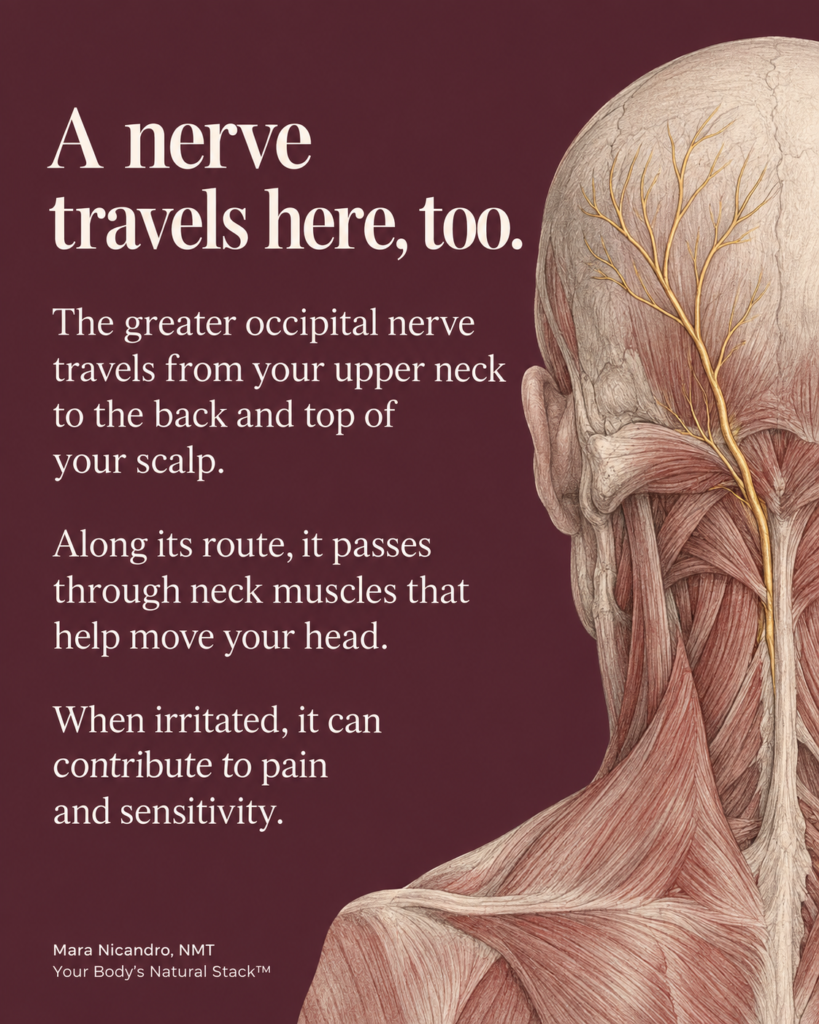
The greater occipital nerve connects your upper neck and scalp
The greater occipital nerve arises mainly from the second cervical spinal nerve, C2. From there, it travels through tissues at the back of your upper neck and supplies sensation to much of the back and top of your scalp.
Along its route, it passes through muscle and connective tissue. Irritation can contribute to pain and scalp sensitivity.
Scalp tenderness also occurs with migraine and other conditions. Therefore, the location alone cannot identify the cause.
How does your brain know where your head is?
Your head needs support and information about its position.
Small muscles beneath your skull, around C1 and C2, contain a high density of muscle spindles. These sensory receptors detect changes in muscle length and contribute to your sense of head position and movement.
At the same time, your brain receives signals from your eyes and inner ears. Together, these inputs help coordinate looking, turning, and balance.
This sense of body position and movement is called proprioception.
Your eyes move. Your neck can respond.
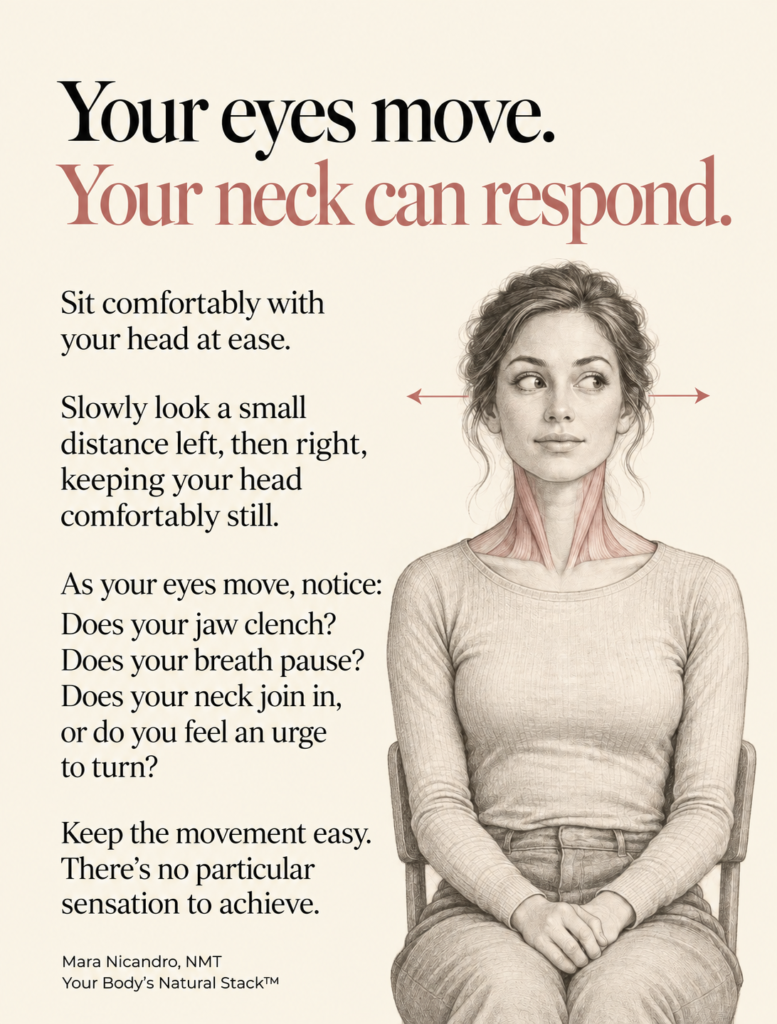
Research has measured changes in neck-muscle activity during eye movement, even when the head stays still. This adds another layer to how your eyes and neck coordinate.
To explore the task, sit comfortably with your head at ease. Slowly look a small distance left, then right, keeping your head comfortably still.
As your eyes move, notice whether your jaw clenches or your breath pauses. Do you feel a change in neck effort or an urge to turn?
Then return your gaze to center. Keep the movement easy and stop if it causes discomfort or dizziness.
You may notice a change or no obvious sensation. This observation helps describe your response to the task; it does not measure how accurate your position sense is.
Notice what happens when you turn
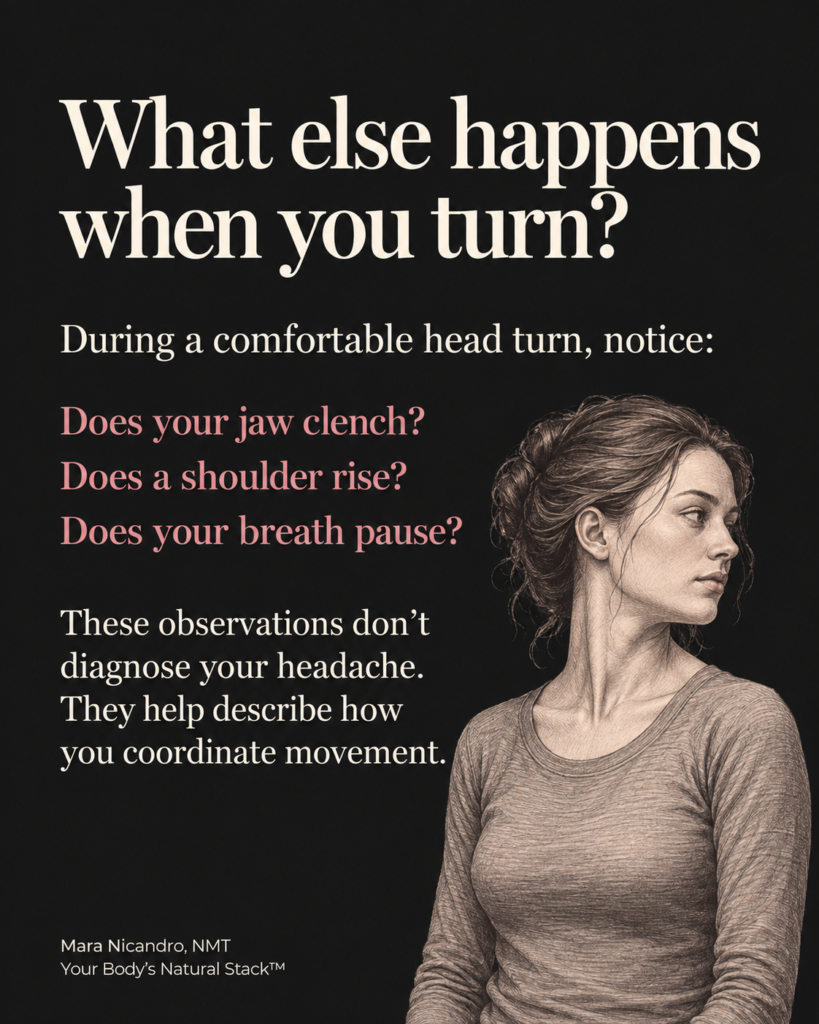
While seated comfortably, slowly turn your head a small distance to each side. Stay within an easy range.
Notice whether your jaw clenches. Is a shoulder rising? What happens to your breathing? Consider whether one direction requires more effort.
Then return to center and take a few comfortable breaths.
These observations describe how you coordinate a familiar movement. They do not diagnose your headache or measure proprioception.
Look at the pattern alongside the tension
When headaches come with recurring neck, jaw, or scalp tension, the accompanying movement deserves attention, too.
A clenched jaw, lifted shoulder, or paused breath can be ways your body holds steady. For example, you may notice them during concentration, movement, or anticipation of discomfort.
Turning toward a second monitor may involve lifting a shoulder and pausing your breath. In that moment, we have something concrete to explore: how the movement happens and where effort increases.
Together, your symptoms, history, and movement observations contribute to the picture.
The reasoning behind Your Body’s Natural Stack™
Your Body’s Natural Stack™ explores how your head, ribs, and pelvis organize together as you stand, move, and breathe.
The purpose is comfortable support and more options for sharing effort. For example, this can include observing where your jaw, neck, or shoulders participate, then comparing comfort and effort after appropriate care or guided practice.
Stacking isn’t about holding yourself in place.
Instead, it’s about giving your body options for managing movement, breathing and effort.
What happens between sessions matters
You may feel more comfortable after a session, then notice familiar tension during reading, driving, or screen time.
That does not mean you have done something wrong. Rather, it gives us information about when the sensation returns and what you are doing at the time.
Home practice offers opportunities to explore movement with less jaw clenching, shoulder lifting, or interrupted breathing. As you practice, the movements should fit your needs and adapt to your response.
Each observation adds to the picture. Over time, small, consistent practices add up across a week.
A note about headache care
Most headaches are not medical emergencies. If yours are new, changing, or becoming more frequent, check in with your healthcare professional.
A sudden, extremely severe headache, or one accompanied by new weakness, confusion, difficulty speaking, vision loss, or fever with a stiff neck, needs emergency care.
Continue at your own pace
My At-Home Headache Relief guide brings movement observations and home practices together so you can revisit them between sessions.
If jaw tension is part of what you notice, my jaw guide offers a companion resource.
Explore the At-Home Headache Relief guide.
Mara Nicandro, BCTMB, NMT
Your Body’s Natural Stack™
References
- Anatomy, Head and Neck, Scalp, StatPearls
- Occipital Neuralgia, Johns Hopkins Medicine
- Quantitative study of muscle spindles in suboccipital muscles of human foetuses, Kulkarni and colleagues, 2001
- The effect of posture on neck proprioception and head/neck stabilization in asymptomatic participants, Smith, Haug and Walsh, 2019
