
You have tried stretching, posture drills, and breathwork, yet something still feels off. The tension returns, the pain moves, and your body keeps whispering that something deeper is at play.
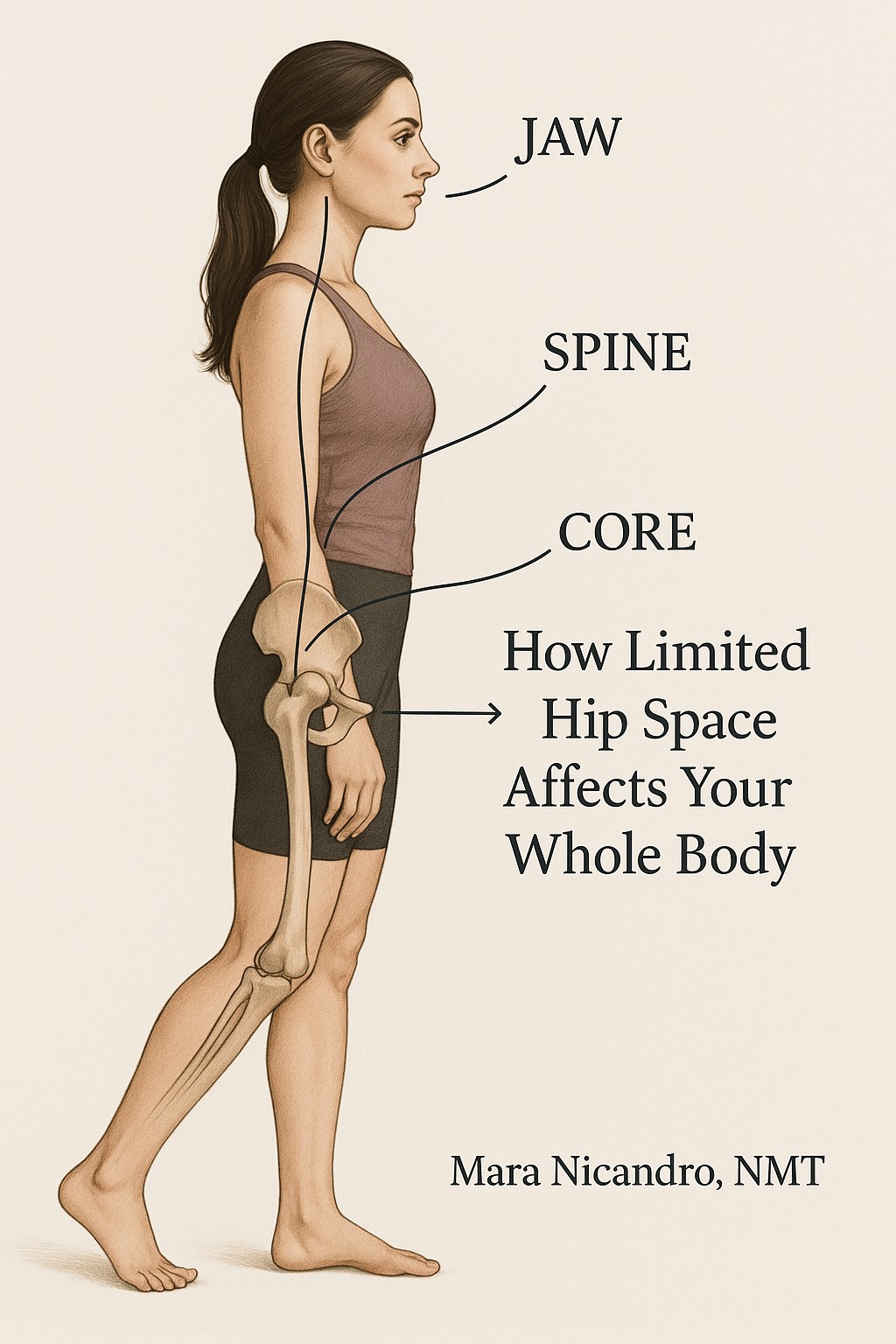
Most people think hip mobility matters only for athletes or folks with tight hamstrings. In reality, limited hip space can quietly disrupt your entire body, including the jaw, the breath, and even lymphatic drainage.
This is not only about flexibility. It is about how the brain organizes movement.
What does “lack of hip space” mean?
The ball‑and‑socket joint of the hip needs room to glide and rotate. When that space is lost through chronic tension, poor posture, or long‑term compensation, the body works around it. Other areas are forced to take on extra jobs.
Instead of the hip supporting weight and rotation, the low back, jaw, and neck step in. The result is gripping patterns, shallow breathing, and stress in places you would not expect.
“I thought my jaw was the problem, but it turned out to be my hip.”
That is what one client told me after a session.
The body never isolates issues the way we imagine. When one part loses function (like the back of the hip), another part steps in. Often, it is the jaw.
Your nervous system is simply trying to keep you upright and safe. Borrowed stability, however, breeds tension where you would least expect it.
Client Story: The Jaw‑Hip Connection in Real Life
Elena (anonymous client) came in feeling stuck. Her jaw tension had worsened, and nothing she tried (mouth guards, foam rolling, meditation) seemed to help. She also experienced frequent headaches, occasional dizziness, and that heavy, congested feeling through her shoulders and neck. Her head sat forward from her shoulders in that classic C7 pattern. She wasn’t sleeping well, which was affecting her daily life and energy levels. She felt as if her body were working against her.
During our session I saw something else. Her body was not loading onto her left hip. A quick single‑leg stance test showed her shifting off that side right away. The glute was not firing, and the hip sat slightly forward. But the effects went far beyond her hip—her right elbow, forearm, and hand felt puffy and congested, her neck was tight, and even her adductors and piriformis showed signs of compensation. During assessment, I also noticed restrictions in her eye movements and that her suboccipital muscles at C1 and C2 were overworking to help turn her head, particularly when looking left, and on the right side something seemed to be blocking normal rotation.
That lack of space triggered a chain reaction: the pelvis could not stabilize, the core gripped, and the jaw over‑compensated. Meanwhile, lymphatic drainage had slowed in these congested areas, creating a cycle where poor movement patterns led to fluid stagnation, which further limited mobility.
Once we restored posterior glide in the hip and brought the breath down into her ribs, her jaw began to soften—without any direct work on her face. As her hip regained stability and her breathing deepened, the congestion in her right arm began to clear, and the tightness through her neck and adductors started to release. Creating space and safety in the foundation changed everything.
Elena had tried everything. What created progress was permission for her body to ground again through the hip. Her nervous system only needed the right input: not force, not perfect posture, just support.
Why this pattern matters
Jaw tension is often compensation When hips cannot ground you, the brain recruits stabilizers higher up. The jaw, shoulders, and neck step in.
Breathing adapts as well Without access to the back of the hips, the diaphragm cannot fully drop. Breathing stays shallow in the upper chest. That limits nervous‑system regulation and reinforces tension.
Lymphatic drainage slows The diaphragm acts as a pump for lymph. Limited hip space usually pairs with poor abdominal mobility and shallow breathing, which reduce lymph flow around the lower abdomen, groin, and pelvic floor. When lymphatic drainage slows, tissues become congested and inflamed, creating additional stiffness that reinforces compensation patterns.
Chronic pain patterns develop When compensation continues long-term, tissues adapt to inflammation and altered movement patterns. Years of compensating with the jaw wire these clenching patterns deeply into the nervous system – the brain learns to recruit the jaw automatically whenever the body feels unstable. This creates a cycle where pain reinforces protective guarding, lymphatic stagnation increases tissue irritation, and the nervous system maintains the compensation that started the problem. Breaking this cycle requires addressing both the mechanical dysfunction and the tissue inflammation simultaneously.
Signs this may be happening
You avoid or struggle with single‑leg stance.
You clench your jaw or tense your neck during exercise.
Your breath does not reach the lower ribs or pelvic floor.
You experience tightness in the groin, front of hip, or low back.
You notice swelling or heaviness in your lower body by day’s end.
What you can do
Stages like perimenopause make this reset even more important. Restoring symmetry, improving breath, and coordinating muscles all influence bone health and long‑term resilience.
Try building these habits:
Practice lateral breathing to engage the diaphragm and support spinal stability.
Spend time in single‑leg stance or gentle balance work to improve proprioception.
Keep a relaxed jaw throughout movement; this calms the nervous system.
Use breath‑led motion to reduce gripping and restore natural alignment.
Creating hip space is the first step. From there you can retrain the body to stabilize and move from the right places, bringing relief to areas that have been working overtime.
Here’s how to start creating that foundational change your body needs:
4 Ways to Improve Your Body’s Stack (Based on How the Body Really Works)
These are not quick trends. They match the way muscles, joints, breath, and the nervous system naturally coordinate.
Breathe into your ribcage, not only your belly Lateral breathing organizes the spine, hips, and core without over‑gripping and helps restore the natural coordination between breath and stability.
Stand or move with a soft jaw A clenched jaw keeps the nervous system in defense mode. Relaxing it resets head‑neck‑hip alignment and sharpens proprioception.
Shift weight side to side on purpose Hip shifting includes both weight transfer and natural rotation, the foundation movements that underlie all functional activity. Controlled single‑leg stance or gentle hip shifts with rotation teach the body where space is missing and how to build true stability from the ground up.
Stack head over ribs, ribs over pelvis This is the body’s natural blueprint. When these zones fall out of sync, muscles overwork and tension becomes chronic.
Bonus: Use dry brushing to support lymph flow A few minutes of gentle dry brushing before movement stimulates lymphatic drainage. Better fluid flow reduces puffiness and helps muscles activate, especially after injury, surgery, or long periods of sitting.
These principles form the Your Body’s Natural Stack™ method, which integrates kinetic chain theory, nervous system regulation, and lymphatic optimization to address the root cause of compensation patterns rather than just symptoms. By restoring hip space and coordinating breath with movement, this approach helps you move from compensation into calm, functional alignment. If this resonates with you, I would love to guide you in a session, or you can learn more in my book [link to book].
Your body is not broken; it is adapting.
What feels like tension is often your nervous system asking for help with breathing, grounding, and space. The moment your body feels supported it starts to soften. Relief does not always come from doing more. It often arrives when you give your body the input it has been waiting for.
If this story feels familiar, let us check how your hips are loading in your next session. Or share this post with someone who keeps wondering why their jaw tension lingers even though they are doing all the right things.

Submit your review | |