
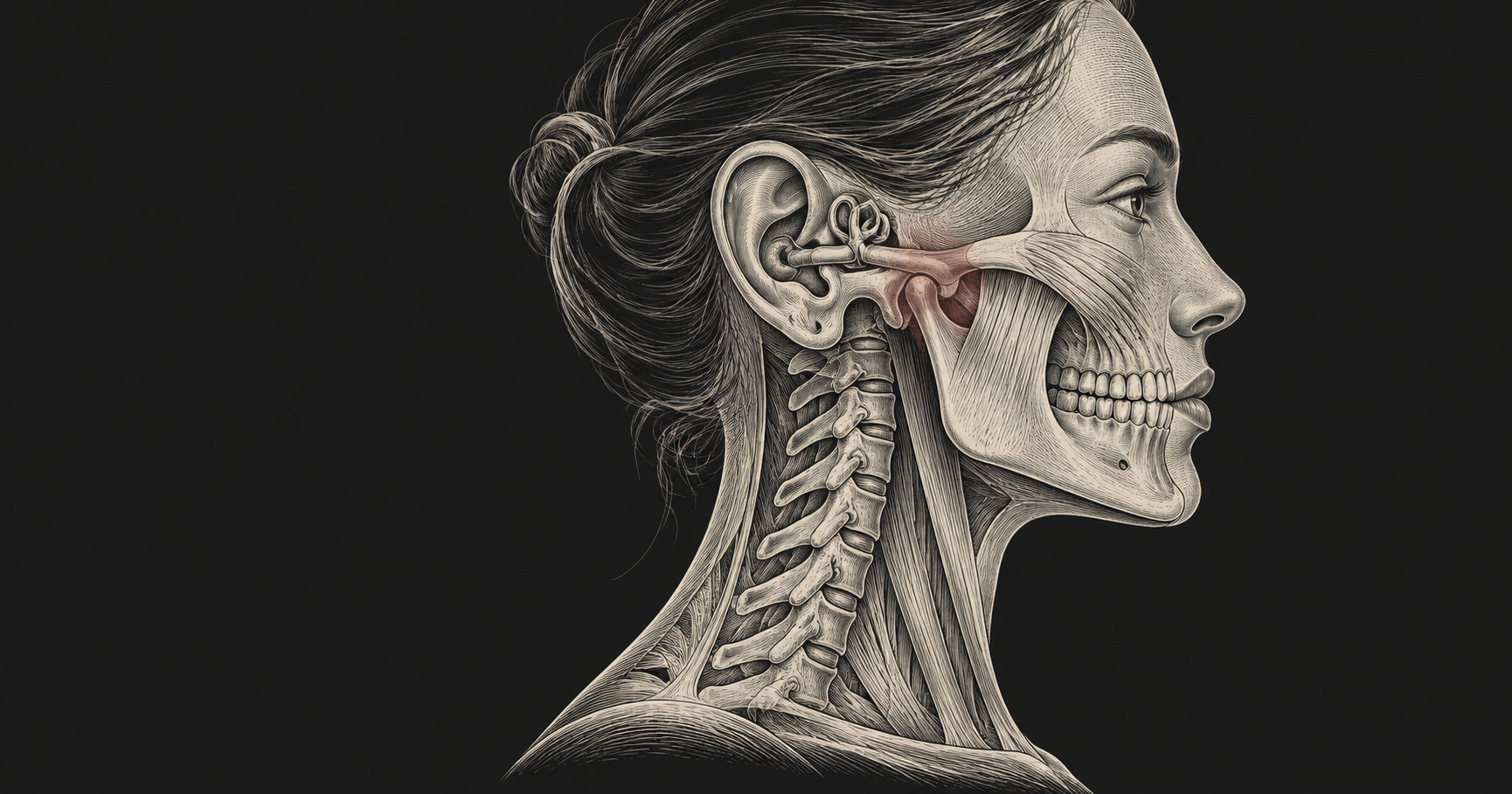
Tinnitus is often talked about as something happening only in the ear.
For many people, the auditory system is central to the picture, and appropriate medical or audiological evaluation should always be the starting point.
But some people notice something else.
The ringing, buzzing, humming, or other sound changes when they move their jaw, turn their head, or change the position of their neck.
Not everyone. Not always. And the response may be subtle.
But when the sound changes with movement, that response gives us information.
A Simple Self-Check
Sit comfortably and notice the sound you hear right now.
You do not need to change it. Just notice it.
Then, one at a time:
- Gently bring your teeth together for a moment, then let your jaw soften.
- Slowly open and close your mouth within a comfortable range.
- Turn your head comfortably to the right. Come back to center. Then turn to the left.
- Bring your chin slightly toward your chest, then return to where you started.
Do not strain or try to make something happen. Stop if a movement causes pain, dizziness, or distress.
After each movement, notice the sound.
Did it become louder or quieter?
Did the pitch change?
Did it feel different in one ear than the other?
Or did nothing change?
There is no right response. You are noticing whether changing something in your body changes what you hear.
If it does, that gives us another piece of information.
If it does not, movement-related modulation may not be the first pattern to explore.
Does a Change Mean the Tinnitus Is More Severe?
No. Movement-related change and tinnitus severity are not the same thing.
There is no universal system that places every experience of tinnitus into a simple level based on the sound alone.
Clinicians may consider how long it has been present, whether it is constant or intermittent, where it is perceived, whether it seems to pulse with the heartbeat, and how much it affects sleep, concentration, emotional well-being, and daily function.
Questionnaires such as the Measuring Tinnitus can help measure that daily impact. They do not tell us what caused the tinnitus or whether the jaw and neck are involved.
Someone may notice a strong change with jaw movement but experience little disruption in daily life. Another person may notice no movement-related change but find the tinnitus deeply disruptive.
These are different pieces of information.
If the sound changes when you move, it does not automatically mean the tinnitus is becoming worse. It means movement-related sensory input may be influencing what you perceive.
Why Can Moving Your Jaw or Neck Change What You Hear?
Research describes this as somatosensory modulation of tinnitus.
A 2023 review of somatosensory tinnitus research describes how sensory information from areas including the jaw and cervical spine can influence pathways involved in auditory processing.
In plain language, information from the jaw and neck does not remain completely separate from the system processing sound. One area where this information may interact is the dorsal cochlear nucleus in the brainstem.
This may help explain why changing the position of the jaw, head, or neck temporarily changes the tinnitus some people perceive.
It does not mean a tight jaw or neck muscle caused your tinnitus.
It does not mean every case involves the jaw or neck.
It does not mean changing one muscle will make the sound disappear.
It means something more useful:
If changing an input changes the sound, that response gives us another part of the pattern to investigate.
This Is Where I Look Beyond the Ear
When a client tells me their tinnitus changes with movement, I am not trying to chase the sound or find one muscle to blame.
I am looking at coordination.
Does the jaw shift as it opens?
Does the neck begin participating when the jaw moves?
Is the tongue resting comfortably, pressing, or bracing?
Does the head position change when the jaw or tongue position changes?
Is one side organizing movement differently from the other?
What happens to breathing as the jaw and neck are asked to do more?
The important part is not any one finding by itself. It is what changes when we change an input and reassess.
This is part of what I mean by Your Body’s Natural Stack™.
No system in the body works alone.
The jaw does not move in isolation from the neck, tongue, head, or breath. Those areas are also responding to information coming from the rest of the body.
Recognition Comes Before Change
Noticing that your tinnitus changes with movement does not tell you what caused it.
It gives you a place to begin asking better questions.
You may start noticing where your tongue rests, whether your teeth are touching when they do not need to be, or whether your neck and shoulders become more active when your jaw tightens.
You may also notice what you were doing immediately before the sound changed.
You are not trying to change the pattern in that moment.
You are learning to recognize how your body responds. That awareness gives us a clearer place to begin.
One Important Boundary
This kind of observation is not a substitute for medical or audiological care, and it cannot diagnose what is causing tinnitus.
If your tinnitus is new or sudden, only in one ear, seems to pulse or beat in time with your heartbeat, or comes with a sudden change in hearing, please seek an appropriate medical or audiological evaluation promptly.
If you have already been evaluated and notice that the sound changes when you move your jaw, head, or neck, that response may be worth exploring more closely.
What a Discovery Session Looks At
A Discovery Session is not built around deep pressure or forcing an area to change.
It is built around observing how your jaw, tongue, head, neck, breathing, balance, and movement coordinate. We compare sides, change an input, and reassess.
Did your neck respond differently?
Did your jaw move differently?
Did breathing become easier?
Did the sound change?
The goal is not to declare what caused your tinnitus. It is to determine whether a movement-related pattern may be relevant to what you are experiencing and what your response tells us about where to look next.
In studio, this can include movement assessment and hands-on assessment. Virtually, we can observe visible movement, breathing, jaw and tongue coordination, balance, and how your responses change in real time.
If you are ready to have your individual pattern assessed, you can book a New Client Discovery Session.
Wicker Park · Clarendon Hills Tuesdays · Virtual nationwide
Start With the Free Tinnitus Pattern Guide
If you want to explore your own responses first, The Tinnitus Pattern Guide walks you through the self-check and explains what to notice in your jaw, neck, tongue, breathing, and movement.
You are not trying to diagnose yourself or make the sound change.
You are gathering information about how your body responds.
Download the free Tinnitus Pattern Guide
Mara Nicandro, NMT
Author, Your Body’s Natural Stack™
nmtforhealth.com
(312) 451-5771
