What breathing, stability, and compensation patterns reveal about your body
After 23 years of practicing neuromuscular therapy in Chicago, I have seen the same pattern repeat itself hundreds of times.
A client comes in with chronic jaw pain. The jaw is released. It feels better for a few days, sometimes a week. Then the tension comes back.
The same cycle shows up with neck pain, shoulder tightness, low back pain, and hip dysfunction.
Release. Relief. Return.
For many years, I did what I was trained to do. I treated the symptom. I found the tight muscle, released it, and sent the client home with stretches.
Still, the pattern kept repeating.
Eventually, it became clear that chronic jaw, neck, and low back pain are rarely isolated problems. They are compensation patterns. Intelligent adaptations the body makes when breathing, stability, or support are compromised and the system no longer feels secure.
That realization became impossible to ignore during COVID, when stress, disrupted routines, and shallow breathing patterns amplified these compensations across the body.
This isn’t a matter of willpower or doing more. The lymphatic system responds to movement and pressure change. When tension softens, circulation can return.
Why Chronic Pain Keeps Coming Back
Most people are not dealing with a single issue. Rather, they are dealing with a system that has been compensating for a long time.
Pain tends to appear where the load is highest or closest to the brain. Commonly, this shows up in the jaw, the neck, or the low back.
However, the symptom is not the source. It is the signal.
When one area loses support, the body adapts to stay upright and functional. Over time, those adaptations become default patterns. As a result, pain returns even after good treatment.
This is why relief is often temporary. The compensation is addressed, but the reason it developed is not.
COVID Revealed Compensation Patterns at Scale
In March 2020, the world shut down.
Suddenly, millions of bodies were exposed to the same conditions at the same time. Because of that, patterns that once appeared individually became visible everywhere.
Restricted breathing from masks led to shallow, chest dominant breathing and increased jaw tension. At the same time, lockdowns reduced walking and daily movement, weakening the feet, ankles, and lower legs. Meanwhile, chronic stress and uncertainty kept nervous systems in protection mode for months, not weeks.
As a result, the symptoms were predictable.
Jaw clenching
Neck pain
Shoulder gripping
Upper back tension
Low back dysfunction
What stood out was not the symptoms themselves. Instead, it was how consistent the pattern was.
COVID did not create these compensation patterns. Rather, it exposed them.
When everyone experienced the same stressors, bodies adapted in similar ways. For the first time in my career, the full picture became clear.
The foundation weakened. Breathing mechanics shifted. The nervous system stayed on high alert. Consequently, everything above the foundation began gripping to compensate.
That was when I realized I had been treating the dam instead of restoring the wave.
Your Body Isn’t Broken. It’s Adapted
Think of your body like a river system.
When flow is clear, water moves freely. Breath travels down on the inhale and up on the exhale. Lymph drains. Fascia glides. Muscles coordinate without gripping.
However, when flow is blocked at the foundation, pressure builds upstream.
That pressure does not signal failure. On the contrary, it reflects adaptation.
Jaw tension is not a jaw problem.
Shoulder pain is not a shoulder problem.
Chronic low back pain is not a back problem.
Instead, these are compensation patterns. They are intelligent responses to instability lower in the system.
During COVID, this played out in real time. Reduced movement and restricted breathing created dams. In response, the body gripped higher up the chain to stay stable.
QL. Spine. Shoulders. Neck. Jaw.
This is not dysfunction. It is survival.
Why Treating the Symptom Doesn’t Work Long Term
Most bodywork and physical therapy approaches focus on where it hurts.
Tight jaw leads to jaw release.
Tense shoulders lead to shoulder work.
Low back pain leads to hip stretching.
While this can help, the relief is usually temporary.
It is similar to bailing water out of a boat without fixing the leak.
You can release the dam repeatedly. Still, if the foundation remains unstable, the dam rebuilds itself.
That is why pain keeps coming back.
The Natural Stack and How the Body Is Designed to Work
The body is designed to function as a stack.
At the base are the feet, ankles, and lower legs.
Above that are the pelvis and core.
Next come the ribcage and breathing mechanics.
At the top sit the neck, jaw, and head.
When the foundation is stable and signals are clear, everything above it works with less effort.
When support is lost at the base, the body compensates higher up the chain. Importantly, this follows predictable patterns through the oblique and deep longitudinal subsystems.
Upper cross syndrome does not start in the shoulders.
Lower cross syndrome does not start in the hips.
Thoracic outlet symptoms do not start in the thoracic outlet.
They start at the foundation.
What Neuromuscular Therapy Reveals About Chronic Pain
Over more than two decades, I have worked with complex clinical presentations including whiplash, thoracic outlet syndrome, and chronic multi site pain.
What became clear is that when proprioception is dimmed at the foundation, the nervous system loses trust in the body.
Congested tissues and restricted joints send cloudy signals to the brain. In response, the brain locks things down.
This shows up as tension, bracing, and holding the breath.
The Protection Safety Shift
When the nervous system does not feel safe, it prioritizes stability over efficiency.
As proprioception dims, fluid movement slows. Muscles begin to grip instead of coordinate.
The body is not choosing pain. It is choosing protection.
Over time, however, living in protection mode leads to chronic patterns, movement limitations, lymphatic congestion, and symptoms that keep returning.
Therefore, the goal is not to force relaxation. The goal is to restore safety.
How I Work With the Body to Restore Stability
I do not begin where it hurts. Instead, I start where support is missing.
First, the foundation is assessed. This includes the feet, ankles, lower legs, joint mobility, and lymphatic congestion.
Next, congestion is cleared and movement is restored. Manual lymphatic drainage, gentle fascial work, and visceral support help tissues function again.
Then, proprioception improves. As signals clear, the nervous system begins to trust the body.
When the foundation feels safe, the dams release naturally.
Jaw tension softens.
Shoulders drop.
QL lets go.
This happens not because the body is forced, but because gripping is no longer needed.
Why Daily Practices Matter for Lasting Change
Sessions create the shift. Daily practices maintain the environment.
Clients who experience lasting change are not only receiving treatment. They are also supporting their bodies between sessions.
Simple daily practices help reinforce this process.
Toe spacers restore foundation awareness.
Gargling and rinsing support lymphatic flow.
Align and Breathe maintains coordination.
Awareness of posture and breath prevents old patterns from returning.
These practices are not optional. They are foundational.
By supporting circulation, proprioception, and nervous system regulation, the body no longer defaults to protection mode.
Who This Approach Is For
This approach is for people who want to understand why their pain developed and what their body needs to change.
It works best for those willing to engage in daily practices, curious about how the body adapts, and patient with steady reconditioning.
On the other hand, it may not be a fit for those seeking quick fixes or passive treatment only.
The body is capable of reorganizing. It simply needs the right conditions.
Why I Wrote Your Body’s Natural Stack™
After years of explaining this framework in sessions, clients often said the same thing.
They wanted to take the understanding home with them.
For that reason, I wrote it down.
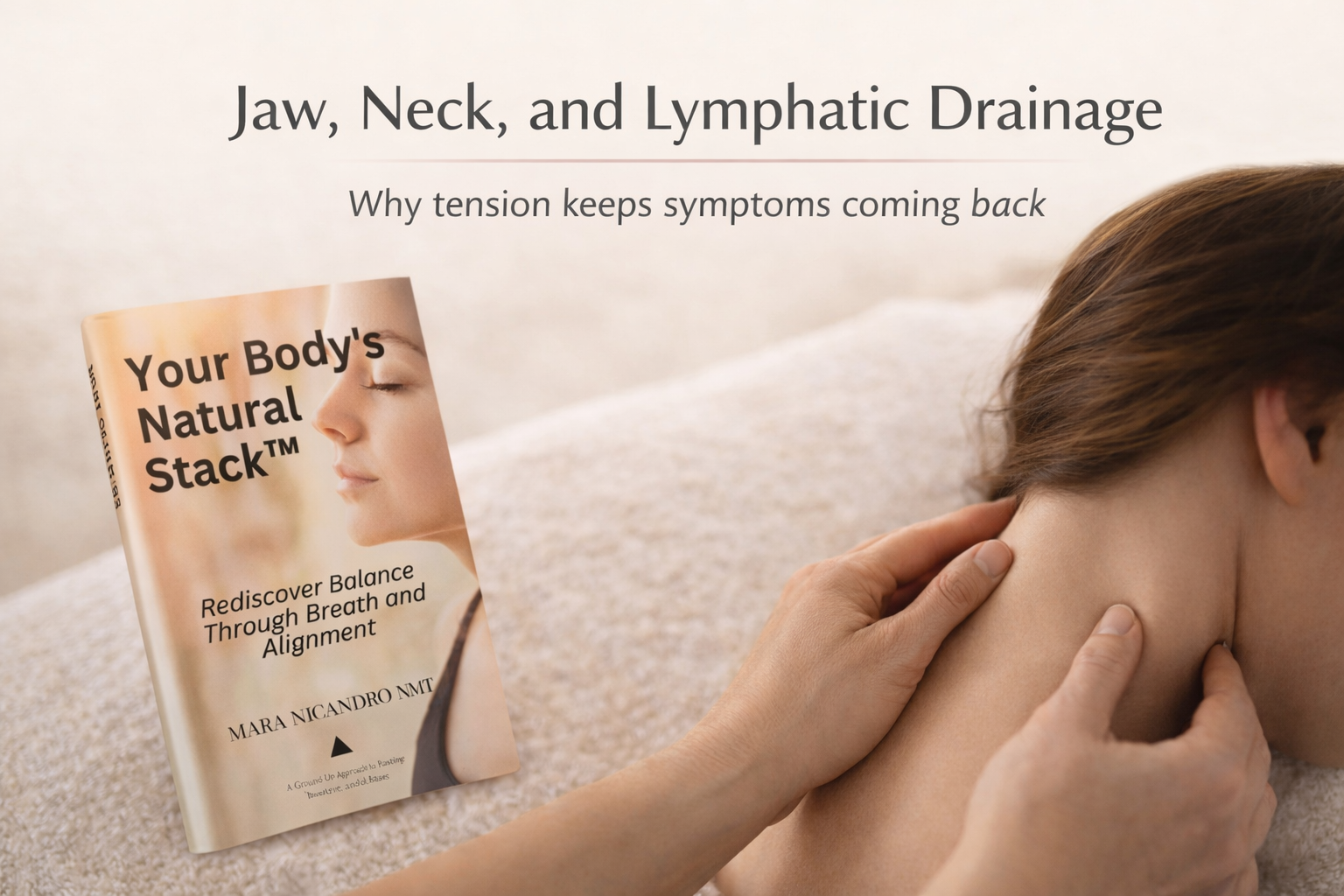
Your Body’s Natural Stack™ explains how compensation patterns form, why pain keeps coming back, and how to restore support from the ground up.
Two Ways to Work With Me
You can begin with the digital book and workbook if you want to learn the framework and daily practices at your own pace.
Alternatively, you can book a Discovery Session where I assess your Natural Stack from foundation to jaw and create a clear roadmap.
Both paths work. Many people choose to do both.
I work with clients in Wicker Park, Chicago, and offer virtual Discovery Sessions for those outside the area.
Your body is not broken. It adapted to keep you safe.
When the foundation feels supported again, the body remembers how to move, breathe, and function with less effort.
That is when the wave restores itself.
