When Hormones Shift, So Does Your Balance: What Reactivity and Muscle Health Reveal
You step off a curb and feel a split-second wobble. Your jaw tightens. Your toes grip the ground. You catch yourself — but something feels… off.
Sound familiar?
As hormones change — during perimenopause, menopause, or periods of high stress — your body quietly adapts in ways you might not notice right away. You may feel more unsteady on one leg, clench your jaw without realizing it, or notice that your muscles feel tight one day and weak the next.
These small signs tell a bigger story about your muscle health, reactivity, and balance.
What Reactivity Really Means
Reactivity is how quickly and efficiently your body senses change and responds.
It’s not just reflexes — it’s a full conversation between your muscles, tendons, joints, and brain. This system tells your body where it is in space, how stable it feels, and whether it needs to tighten or release.
When that communication gets disrupted, your body starts relying on backup strategies. You might grip your toes to stay balanced, clench your jaw to create a sense of control, or hold your breath when your brain can’t find stability through muscle coordination.
Over time, those patterns become automatic — a loop that keeps you tense, reactive, and fatigued.
How Hormones Affect Muscle Health and Balance
As estrogen declines, connective tissues lose some elasticity. Muscles may not activate or respond as efficiently, and the body compensates by using tension to stay upright.
You may notice:
- Feeling “off balance” when turning quickly
- Tight hips or shoulders that don’t release easily
- Slower reaction time when catching yourself from a stumble
- Fatigue after simple movements that once felt easy
These changes aren’t just “aging” — they reflect how hormonal shifts alter muscle tone, tendon health, and proprioceptive feedback (your internal GPS for movement).
Grip Strength and the Feedback Loop
Studies show that grip strength is one of the most reliable predictors of longevity and functional mobility across the lifespan. It’s also one of the most accurate markers of overall neuromuscular health — and it’s often one of the first things to change during hormonal transitions.
A weak or inconsistent grip can signal reduced nervous system efficiency or muscular reactivity throughout the body.
When grip and postural control decrease, the brain receives fuzzier signals from the muscles and joints. That’s when compensations like clenching, bracing, or shallow breathing show up.
The Role of Breath and Lymphatic Flow
Breathing and lymphatic drainage are inseparable from muscle health.
When you hold your breath, lymph flow slows and internal pressure builds, making your body feel “stuck.” Without proper diaphragmatic movement, oxygen delivery and pressure regulation in the abdomen become delayed — your system literally registers late.
That lag in response affects stability, recovery, and even emotional regulation.
Restoring a natural breathing rhythm helps balance internal pressure, improve circulation, and calm the nervous system — essential for coordination and joint health.
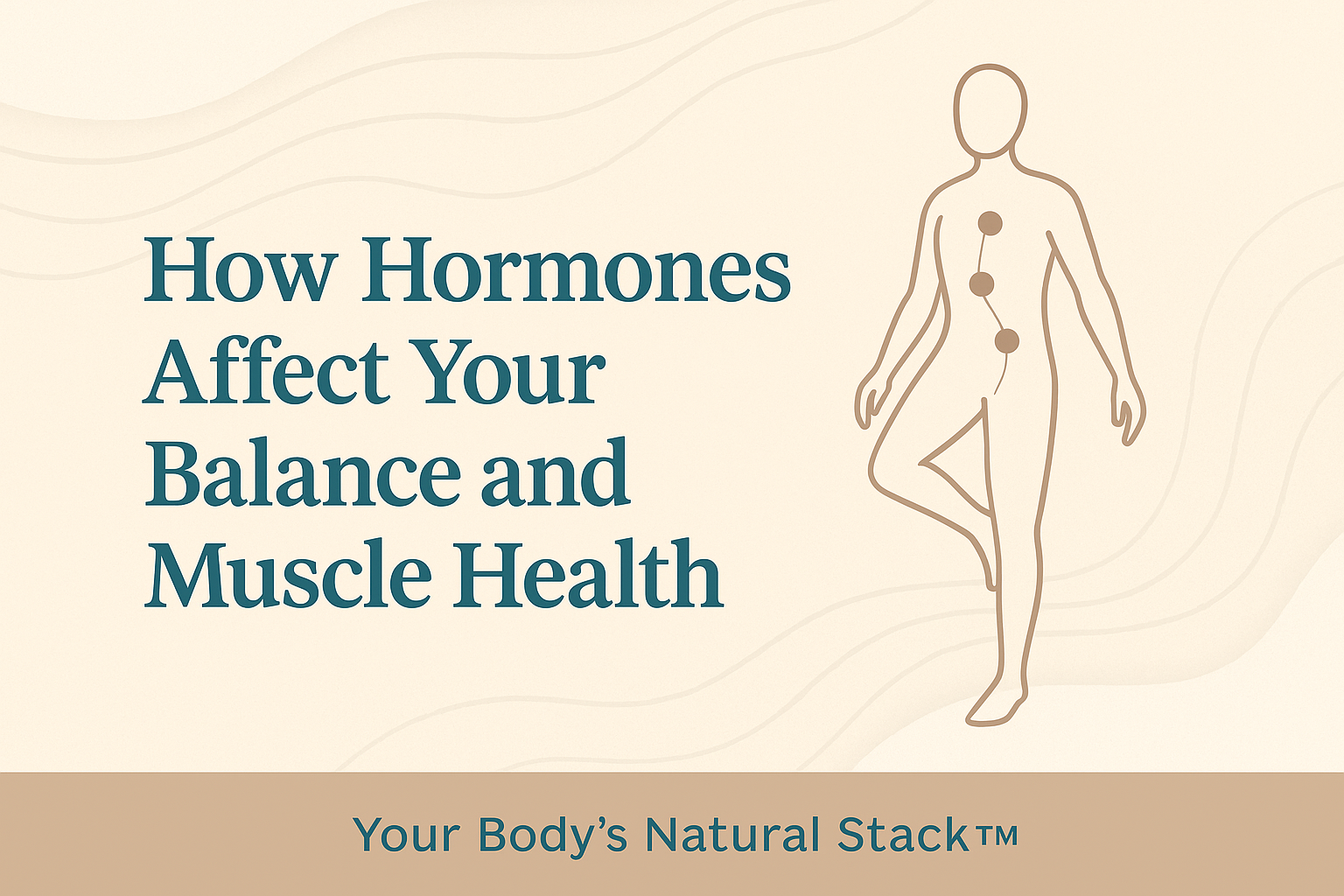
A Simple Awareness Practice: The Single-Leg Stance
Here’s a quick way to assess your body’s reactivity patterns.
The Test:
Stand on one leg for ten seconds.
Notice what happens:
- Do your toes grip the floor?
- Does your breath pause or become shallow?
- Does your jaw tighten?
- Do you wobble immediately or feel relatively stable?
What These Reactions Mean:
Toe gripping suggests your feet are compensating for reduced sensory feedback from your ankles and hips. Your body is working harder than it needs to.
Breath holding means your nervous system is treating balance as a threat. When you can’t breathe while balancing, your body isn’t coordinating — it’s bracing.
Jaw clenching reveals that your brain is searching for stability through tension rather than through efficient muscle activation.
Immediate wobbling may indicate reduced proprioceptive awareness or delayed muscle response — common when hormonal changes affect connective tissue elasticity.
These small reactions are windows into your body’s reactivity. They show where tension is replacing communication.
And here’s what’s really happening:
When you’re locked in these compensation patterns — constantly gripping, bracing, breath-holding — your nervous system stays in fight-or-flight mode. You literally cannot access rest and digest. Your body can’t let go, can’t recover fully, can’t regulate properly.
This isn’t just about balance. It’s about whether your body can shift into parasympathetic mode — the state where healing, digestion, and restoration actually happen.
The Goal:
When practiced with awareness — and supported by therapies that restore muscle coordination and lymph flow — single-leg stance becomes more than a test. It becomes a tool to reconnect your body’s feedback loop.
Over time, you should be able to stand on one leg with:
- Minimal toe gripping
- Steady, natural breathing
- A relaxed jaw
- Subtle micro-adjustments rather than large wobbles
Restoring Reactivity and Balance
Neuromuscular therapy, breathwork, and alignment re-education retrain your body’s ability to sense, respond, and recover.
The goal isn’t just to strengthen; it’s to release the patterns that keep you locked in chronic activation — to restore symmetry, function, and the ability to rest. When your body can let go of compensatory tension, your nervous system can finally shift into parasympathetic mode.
That’s when real healing happens. That’s when you can digest properly, sleep deeply, and move through your day without constant vigilance.
When your muscles can communicate clearly with your brain, when your breath moves freely, and when your body trusts its own coordination, balance becomes effortless again — and rest becomes possible.
🌀 Your Body’s Natural Stack™
Awareness first. Coordination next. Stability follows.
Ready to restore your body’s reactivity and balance? Schedule a Discovery session virtual or on location to assess your neuromuscular patterns and create a personalized plan for rebuilding coordination, strength, and stability from the inside out.
