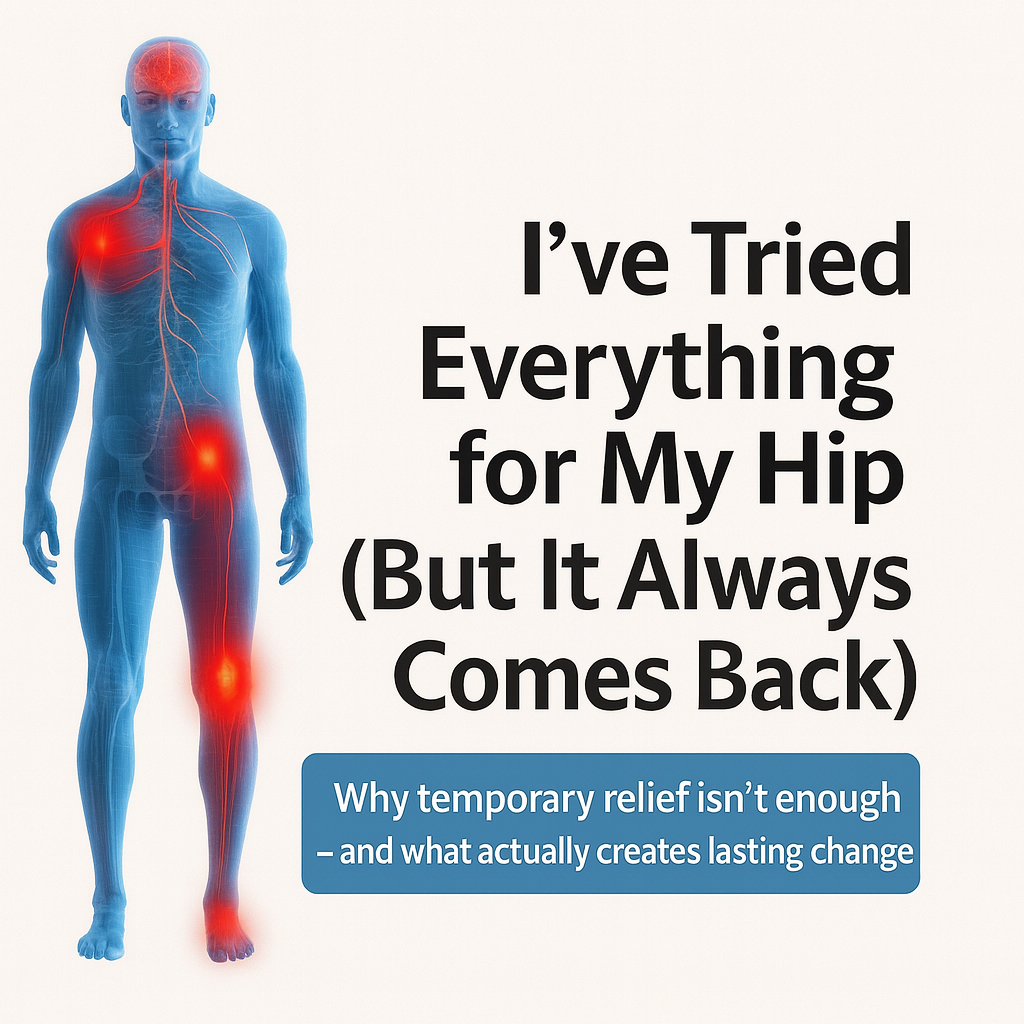
Why temporary relief isn’t enough – and what actually creates lasting change
You’ve been dealing with your right hip for years now.
At first, you thought it was just tightness from sitting too much. So you stretched. It felt better for a few hours.
Then you tried:
- Deep tissue massage (relief for maybe a day)
- Yoga (helps in the moment, doesn’t last)
- Physical therapy (exercises that didn’t seem to “stick”)
- Foam rolling (temporary at best)
- Strengthening your glutes (made it worse somehow?)
You’ve invested hundreds of dollars and countless hours.
And still, that familiar tightness returns. It might show up in your hip one day, your lower back the next, or even migrate to your neck and jaw.
You start wondering: “Is this just aging? Do I need to accept this?”
Here’s what I need you to know: No, this isn’t aging. And no, you don’t have to accept it.
There is a reason nothing has created lasting change. And it’s probably not what you think.
Why Temporary Relief Isn’t Enough
Most approaches focus on the symptom: your tight hip.
Stretch the hip. Massage the hip. Strengthen around the hip.
Yes, these provide relief—temporarily. But here’s what’s actually happening:
Your hip isn’t the problem. It’s doing exactly what your nervous system is asking it to do.
It’s compensating.
Until you address the reason your body created that compensation in the first place, the cycle repeats.
They treat your hip. You feel better. But your nervous system says, “Great, but we still need that compensation,” and recreates the tightness within days.
This is why you can have the same symptom for years despite trying everything. You’re not addressing what’s driving the pattern.
What’s Really Happening
Something happened—maybe years ago. A fall, an old whiplash injury, surgery, or even long-term stress.
Your brilliant nervous system found a solution: create stability through compensation.
For many people, the chain looks like this:
An old neck or breathing issue changes how your core stabilizes → The core stops supporting as it should → The hip steps in to create stability → The hip gets tight and stays tight
It’s not separate problems. It’s one intelligent pattern.
And here’s the thing: as long as your body needs that compensation, it will maintain it.
The Common Thread: Compensation
The tightness you feel isn’t random. It’s your body’s intelligent solution to what it perceives as instability or threat.
That’s why chasing symptoms never lasts. Stretching and releasing the hip gives temporary relief, but the nervous system simply recreates the tension because the underlying pattern hasn’t changed.
The Nervous System Connection:
When that injury or stressful period happened, your nervous system went into protective mode. Fight-flight-freeze activated.
The problem: For many people, that protective mode never fully turned off.
Years after the initial injury healed, the nervous system is still stuck in a subtle state of protection.
How does this show up?
• Shallow breathing (chest instead of belly)
• Jaw clenching (especially during stress or concentration)
• Muscles that won’t fully release (like your hip)
• Difficulty truly relaxing even when you’re trying
• Sleep issues (can’t fully settle)
• That feeling of being “wound up”
Your body never received the “all clear” signal to shift out of protection mode back into normal functioning.
It’s still protecting you from a threat that no longer exists.
This is why stretching doesn’t work. You’re trying to lengthen muscles that your nervous system believes MUST stay tight for your survival.
Your Feet Are Sending Signals
When your feet don’t function optimally—toes gripping, arches collapsing, weight uneven—your nervous system receives faulty information about where you are in space.
This forces compensations up the chain:
Knees adjust → Hips compensate → Core works harder → Low back, neck, and jaw eventually join the party
Toe separators aren’t just about your feet. They help reset your nervous system’s baseline—encouraging toe spread, arch engagement, and balance through the entire body.
The Jaw–Tongue–Toe Connection
Here’s something most people never connect: right jaw clenching often links to left toes that aren’t engaging.
When I assess clients, I often find a tight right jaw, tongue tension, and underactive left toes. This isn’t random. It’s not just fascia either—it’s a learned motor control pattern.
Your nervous system builds cross-body patterns for stability through integrated chains that run from your feet through your hips, across your core, and up into your opposite shoulder and jaw. Research by Andry Vleeming and others has mapped these fascial slings that connect opposite limbs through the core—what they call myofascial force transmission systems.
When one part of the chain isn’t functioning properly, another part compensates.
Try This Right Now:
Stand with your back against a wall. Place your right elbow on the wall at shoulder height. Now gently twist your torso to the right—keeping your elbow in place.
Notice what happens:
- Does your jaw clench as you rotate?
- Do your glutes or hip rotators grip?
- Does the front of your foot bear all the weight while your toes curl?
- Do your quads tense instead of your whole leg working evenly?
- Can you even rotate smoothly, or does it feel blocked?
Now try the other side: left elbow on the wall, twist left. Notice any differences?
This is your nervous system’s compensation pattern in real-time. Your body is gripping in multiple places to create stability—instead of using balanced, functional rotation through your core and integrated chains.
A common pattern:
A chronically tight right hip is often compensating for weakness in the opposite shoulder and limited rotation through your core. The hip grips to stabilize what the upper body and rotational system should be handling.
If your left toes aren’t spreading or grounding properly, the right jaw and tongue step in to provide the “stability” your foot isn’t giving.
The result? Your jaw works overtime, your tongue holds tension, your hip stays tight, and your entire system reorganizes around the compensation.
When we restore proper engagement through these integrated chains—foot function, core rotation, shoulder stability—the jaw and tongue can finally release. Not because we stretched them, but because they no longer have a job to do.
And here’s the connection most people miss: When your jaw clenches chronically, it reinforces the freeze state throughout your entire body.
Your jaw is intimately connected to your nervous system’s threat response. Chronic jaw tension signals to your brain that you’re still under threat—which keeps the freeze response active—which keeps everything else (your hip, your neck, your breathing) locked in compensation patterns.
The Freeze Connection: When Your Body Gets Stuck
Here’s something most practitioners miss entirely:
Your body has three responses to threat: Fight, Flight, and Freeze.
Everyone knows about fight-or-flight. But freeze? That’s the one that traps people in chronic pain.
Many clients don’t realize that breath-holding is part of why tension persists. When you hold your breath, your body hits the pause button. Not just in your lungs—but in your neck, jaw, and core. It’s like pressing freeze frame on your muscles.
Understanding the Freeze Response
Neuroscientist Stephen Porges’ research on the polyvagal system shows that when fighting or fleeing isn’t possible—or when stress becomes chronic—the nervous system defaults to a freeze state. This isn’t just a metaphor. It’s a physiological state where:
- Your muscles become rigid
- Your breathing becomes shallow
- Your body enters a state of protective immobility
This keeps your nervous system stuck in protection mode, and your hip gripping becomes part of that freeze pattern.
How Freeze Creates Chronic Pain
Peter Levine’s work on trauma and the body demonstrates that freeze-like responses in humans are directly linked to chronic pain conditions. When you’re in freeze:
• Muscles won’t release (even when you stretch them)
• Movement feels threatening (“What if I make it worse?”)
• The body guards protectively (even when there’s no current injury)
• Feeling stuck becomes literal (not just metaphorical)
This is especially common with diagnoses like frozen shoulder, chronic neck pain, and hip that won’t release no matter what you do.
Recognizing Freeze in Your Daily Life
You might not realize you’re in freeze, but your body gives you clues:
• Your jaw clenches during work calls, while driving, or when concentrating
• Breath-holding happens without you noticing (especially during stress or focus)
• Your shoulders creep up toward your ears throughout the day
• Feeling “wired but tired” becomes your baseline – alert but exhausted
• Bracing before movement becomes automatic – getting up from a chair feels like you need to prepare
Notice what happens right now as you read this:
- Is your jaw clenched?
- Are your shoulders tense?
- Is your breathing shallow?
That’s freeze. It’s so constant you’ve stopped noticing it.
You’re not stuck in your muscles. You’re stuck in your nervous system.
Breaking free from freeze requires helping your nervous system understand that it’s safe to move, breathe, and release. You can’t force it. You have to convince it.
Why Movement and Breath Matter
Your muscles aren’t just for movement—they’re pumps that circulate blood, move lymphatic fluid, nourish joints, and keep tissues healthy.
But when muscles stay in chronic gripping patterns (like hips, jaw, or QL):
Circulation decreases → Fluids stagnate → Joints stop getting proper lubrication → Tissues become more irritable
This isn’t about “detox”—it’s simple physiology. Your body is designed to move and breathe.
Think of it this way:
- Moving muscles = pumping action → fluids circulate → tissues stay healthy
- Gripping muscles = restricted flow → fluid stagnation → tissues become congested
This affects: • Joint health – Synovial fluid needs movement to nourish cartilage
• Muscle function – Metabolic waste buildup makes muscles more irritable
• Core tissues – Stagnant areas don’t heal efficiently
• Spinal segments – Restricted movement between vertebrae limits circulation
Deep breathing, core stability, and functional patterns restore circulation and teach your nervous system that it’s safe to release chronic gripping.
The Sleep-Recovery Connection
Here’s what many people don’t realize: chronic freeze and gripping patterns directly impact your sleep quality and recovery.
When your nervous system is stuck in protection mode:
- Deep, restorative sleep becomes difficult to achieve
- Your body can’t complete necessary repair processes
- Growth hormone release (which happens during deep sleep) is reduced
- Inflammation doesn’t decrease overnight like it should
- You wake up feeling unrested, even after 7-8 hours
Poor sleep then creates a vicious cycle:
Inadequate recovery → tissues stay irritable → nervous system stays on alert → freeze persists → sleep suffers → repeat
This is why a holistic approach matters. We can’t just address your hip, or just work on your breathing, or just release your jaw. Your entire nervous system needs to shift out of the freeze-protect-compensate cycle so your body can actually sleep deeply, recover completely, heal effectively, and return to functional movement patterns.
When clients tell me “I’m finally sleeping through the night” or “I wake up feeling rested now”—that’s when I know their nervous system is making the shift. The pain relief follows.
Why Pain Becomes Chronic: Your Nervous System Learns the Pattern
Over time, the nervous system learns these protective patterns. They become ingrained.
Research demonstrates that chronic pain involves significant neuroplastic changes in the brain—structural and functional alterations in pain-processing regions. Your brain literally rewires itself around the pain experience.
Think of it like this:
Year 1: Your hip tightens after an injury. Your brain creates a neural pathway for that pain signal.
Year 2: The pathway gets reinforced. Every time the pain fires, that neural “highway” gets stronger, faster, more automatic.
Year 3+: The pain pathway is so well-established that it can fire even without ongoing tissue damage. Your nervous system has learned chronic pain.
That’s why pain feels like it always comes back—your body is simply replaying the pattern it has practiced for years.
The Good News:
Patterns can be retrained. If your nervous system can learn a pain pattern, research shows it can also unlearn it. Neuroplasticity works both ways.
With the right inputs—breath, proprioception, functional resets—your nervous system can unlearn old strategies and build new ones.
But here’s the catch: You can’t unlearn a pattern while your body still needs the compensation.
The Compensation Cycle: Why It Always Returns
Let me show you the cycle that keeps you stuck:
Day 1: Your hip is tight. You book a massage.
Day 2: The massage releases your hip. You feel amazing! “Finally! This worked!”
Day 3-4: The tightness starts creeping back. “Hmm, maybe I need to stretch more.”
Day 5: Full tightness is back. “Why didn’t the massage last?”
Here’s what actually happened behind the scenes:
Day 1: Hip is compensating for core instability, freeze-state nervous system, learned pain pattern
Day 2: Massage releases hip (symptom addressed)
But: Core still unstable, freeze still active, neural pattern unchanged
Same day (4 hours later): Nervous system scans: “Core can’t create stability” ✓ Still true
Same day (8 hours later): Nervous system says: “We need that compensation back”
Day 3-5: The established neural pathway reactivates automatically, hip tightness recreates itself
Your nervous system isn’t being stubborn. It’s being smart.
Until you address WHERE the instability started, the FREEZE response, and the NEUROPLASTIC pattern—the cycle will continue indefinitely.
No matter how many massages you get, stretches you do, strengthening exercises you try, or practitioners you see.
The pattern will keep coming back. Because you’re treating the symptom, not the system.
What This Means For You
Stretching alone won’t fix it.
Strengthening without retraining the pattern can make it worse.
Relief that doesn’t last isn’t failure—it’s your nervous system protecting you.
Lasting change comes when we:
- Identify the compensation
- Retrain the pattern
- Restore function so the hip no longer has to grip for stability
What This Looks Like
Let me tell you about Sarah (not her real name).
Sarah came to me after 3 years of right hip tightness. She’d done PT twice, saw a chiropractor weekly, did yoga religiously.
“It always comes back,” she said. “Within 2-3 days.”
What the Assessment Revealed
During her assessment, I found:
- Old whiplash injury from 8 years ago (she’d forgotten about it)
- Breathing was entirely into her chest
- Jaw clenched whenever she concentrated
- Right hip was indeed tight—but so was her pelvic floor
- When taking a deep breath, shoulders lifted instead of belly expanding
The hip wasn’t the problem. The hip was the last domino to fall.
The Treatment Approach
We worked on:
- Releasing the neck tension that started the cascade
- Retraining her breathing (which she didn’t even know was “wrong”)
- Teaching her core to actually stabilize
- THEN addressing her hip—which released much easier because it didn’t need to grip anymore
The Results
Six weeks later: “I forgot I even had hip pain.”
Three months later: “It hasn’t come back.”
That’s not because I’m magic. It’s because we addressed the pattern, not just the symptom.
The Difference
Here’s what’s different about this approach:
A Different Set of Questions
Most practitioners ask: “What hurts?”
I ask: “What pattern is your body creating, and why?”
A Different Treatment Philosophy
Most treatments: Release the tight muscle
This approach: Understand why it’s tight, address the root, then release becomes easier and actually lasts
A Different Timeline
Most timelines: “Come back when it flares up again”
This timeline: “Let’s resolve the pattern so you don’t need to come back”
I’m not interested in being your maintenance plan. I’m interested in helping you resolve this so you can get back to living without thinking about your hip every day.
Is This You?
This approach works best for people who:
- ✓ Have been dealing with the same issue for months or years
- ✓ Have tried multiple treatments with only temporary relief
- ✓ Want to stay active and pain-free
- ✓ Are willing to do the work (this isn’t passive treatment)
- ✓ Want to understand what’s happening in their body
- ✓ Prefer addressing the root cause over managing symptoms
- ✓ Notice patterns (jaw clenching, breathing changes, one-sided tightness)
If that sounds like you, let’s figure out what’s actually going on.
Next Step: Discovery Session
Tired of treatments that only provide temporary relief? The Discovery Session identifies why your pain keeps coming back and creates a plan to support lasting relief.
What Happens:
We’ll evaluate the FULL pattern—not just where it hurts. This includes:
- Comprehensive assessment of your movement, posture, and breathing
- Identification of where the compensation started
- Understanding of the connections you might not have considered (jaw, neck, breathing, core, hip—how they all relate)
- Clear explanation of what we find (in plain English, no jargon)
- Immediate techniques you can use at home
You’ll Leave With:
- ✓ Understanding of why nothing has worked long-term
- ✓ Clear explanation of what’s actually driving your symptoms
- ✓ Our customized 7-Day Reset Program to begin retraining your nervous system
- ✓ Personalized treatment plan for lasting results
- ✓ Whether we’re a good fit to work together
After Your Discovery Session:
If we’re a good fit, we’ll collaborate on continuing care designed specifically for your pattern. Together, we’ll fine-tune your 7-Day Reset and create a path forward that addresses the root cause—not just manages symptoms.
This isn’t about becoming dependent on treatment. It’s about giving your nervous system the tools and support it needs to unlearn old patterns and create lasting change.
Not sure if this is the right fit? Book a free 15-minute phone call first. Let’s talk about what you’ve tried, what hasn’t worked, and whether this approach makes sense for you.
A note on availability: I work with a limited number of clients at a time so I can give each person the attention this work requires. If you’ve been dealing with this for years, a few more days won’t hurt—but spots do fill up quickly.
The question isn’t whether your hip will get tight again. The question is: are you ready to understand why?
Because your hip isn’t broken. It’s been protecting you.
)