
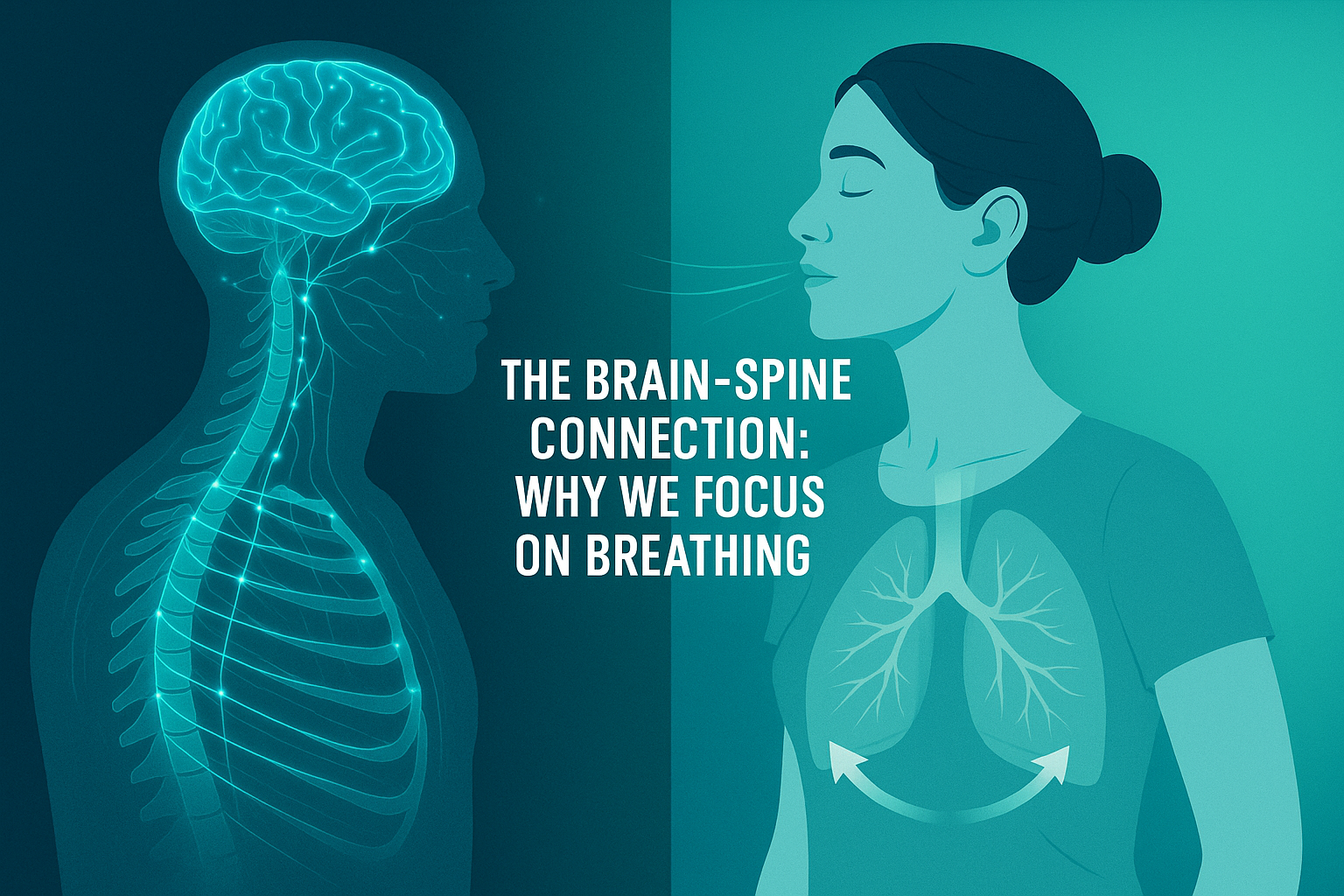
What Does Breathing Have to Do with My Back Pain?
“I’m already breathing. Why isn’t it helping?”
These are the questions I hear most often, and the answer reveals a fascinating connection most people don’t know exists: your brain absolutely knows where your spine is, and how you breathe directly impacts spinal health and natural pain relief.
Who This Approach Helps
This breathing-based approach is particularly effective if you:
- Have tried conventional treatments without lasting relief
- Experience morning stiffness or pain that never quite goes away
- Feel stuck in chronic tension patterns
- Notice your pain worsens with stress
- Want to address root causes, not just symptoms
Your Brain’s Built-In Spine GPS
Your nervous system maintains a detailed, real-time map of your entire body, including every vertebra, muscle, and joint. Through thousands of sensory receptors, your brain constantly receives updates about:
- Joint position and movement
- Muscle tension and length
- Tissue pressure and stretch
- Balance and spatial orientation
When your breathing becomes shallow or dysfunctional, it changes the environment around your spinal joints. Tight accessory muscles, reduced chest expansion, and poor postural alignment interfere with proprioceptive accuracy. Your brain then receives “fuzzy” information about your spine, which can lead to compensatory patterns, reduced coordination, and eventually chronic pain.
Why Your Breathing Stays Altered After Injury Heals
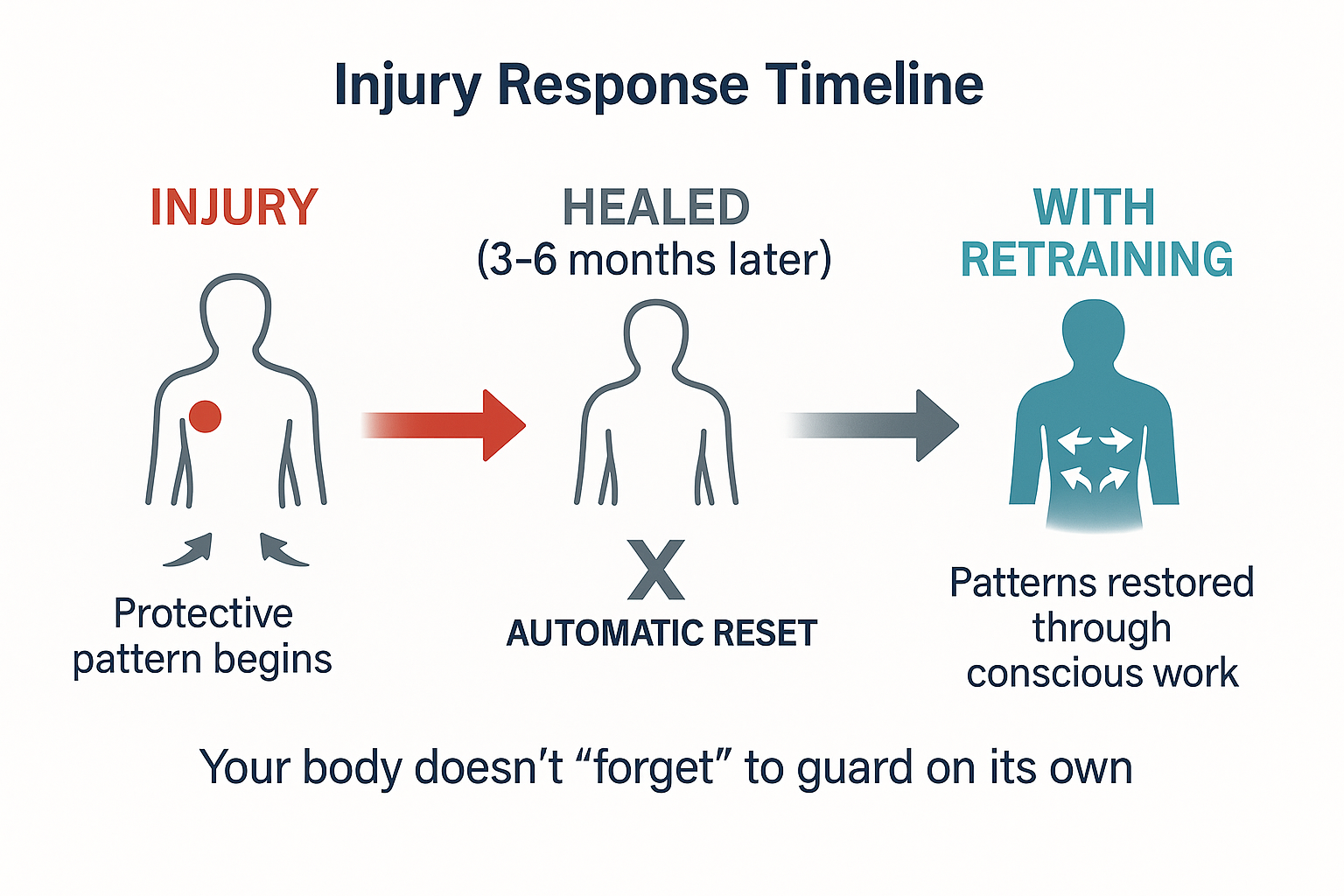
When you experience an injury, illness, or even prolonged stress, your breathing shifts to protective patterns—shallow chest breathing, holding your breath, or overusing neck and shoulder muscles instead of the diaphragm.
The problem? These patterns don’t automatically reset once the injury heals. Research shows altered breathing mechanics can persist for years. Your nervous system simply learned a new “normal.” Without conscious retraining, your body keeps guarding long after the original threat is gone.
The Diaphragm: Your Spine’s Secret Weapon
Your diaphragm isn’t just for breathing—it stabilizes your spine. Picture inflating a balloon inside your torso. The intra-abdominal pressure created supports your lumbar spine and takes strain off the small stabilizing muscles that often become painful.
Deep, controlled breathing also engages your pelvic floor and deep abdominals, creating a coordinated support system your spine relies on.
The QL Connection: How One Muscle Keeps You Stuck
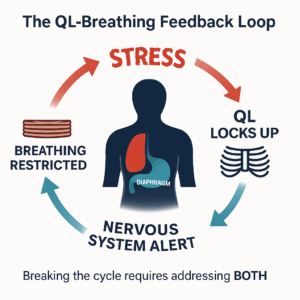 Your quadratus lumborum (QL) is a deep lower back muscle that often holds chronic tension. Stress triggers QL tightness, which restricts diaphragm movement. That forces shallow chest breathing, which signals more threat to your brain—locking you into a cycle of “fight or flight.”
Breaking this loop requires addressing both: releasing the QL and retraining breathing to signal safety to your nervous system.
Resetting Your Nervous System
Slow, rhythmic diaphragmatic breathing shifts your body into parasympathetic mode—your natural “rest and digest.” This:
- Reduces overall muscle tension
- Improves coordination between stabilizers
- Decreases pain perception
- Restores natural movement patterns
Each mindful breath is a mini spinal reset: inhale to lengthen and decompress, exhale to restore alignment.
The Tongue-Posture Connection
Breathing is also influenced by tongue position. Ideally, your tongue rests gently against the roof of your mouth. This supports jaw alignment, keeps airways open, and reduces strain on neck muscles.
When breathing is compromised, the tongue often drops, which:
- Reduces breathing efficiency
- Contributes to forward head posture
- Increases neck tension
- Affects spinal alignment through fascial chains
Including tongue posture with breathing retraining accelerates progress and helps maintain results.
The Hidden Middle Ground: High Nasal Breathing
Some people breathe through their nose but only in the upper passages, with minimal diaphragm use. This “high nasal breathing” quietly overworks the same neck and jaw muscles as mouth breathing. It’s subtler but just as disruptive to spinal health.
Case Study: A Yoga Client’s Breakthrough
One client came to me frustrated that despite years of practice, he couldn’t do gentle backbends at his annual yoga retreat. His spine simply refused to extend.
Together, we focused on retraining his breathing and releasing QL tension. A year later, he returned to the same retreat and found himself able to move into backbends comfortably. His nervous system finally felt safe enough to allow the movement—not because he got more flexible, but because his breathing was no longer guarding his spine.
What to Expect: Your Timeline for Relief
- Many people notice immediate changes—feeling taller, lighter, or breathing more easily.
- Deeper nervous system patterns take 2–3 sessions to shift.
- Chronic issues often require 4–8 weeks of consistent retraining for lasting results.
- Practicing at home accelerates progress significantly.
Your Action Steps for Better Spinal Health
- Observe your breath: Does your chest rise more than your abdomen?
- Try the nasal test: Can you breathe through your nose comfortably for 2–3 minutes with your mouth closed?
- Notice muscle use: Are your shoulders and neck tense at rest?
- Check posture: Is your head forward of your shoulders?
- Improve sleep: Do you wake with dry mouth, sore throat, or morning stiffness?
Simple diaphragmatic breathing, practiced consistently, can restore clear feedback between your brain and spine.
The Bottom Line
Your breath is one of the most powerful tools you have for relieving chronic back and neck pain. By retraining breathing patterns, addressing QL tension, and including overlooked factors like tongue posture, you’re not just treating symptoms—you’re restoring the communication between brain and spine for lasting health.
Healing happens when we work with the body’s natural wisdom, not against it.
Would you like me to also shorten this into a 1,000–1,200 word blog version (for web readability), or keep it as a longer, more educational “pillar” article for SEO?
